Adaptive reuse in commercial real estate is on the rise. No wonder, since it can save time, money, and resources – and it’s in step with a more environmentally friendly approach to industrial and commercial real estate development.
Graffiti typically adorns the walls and boarded up windows of the architectural monuments to a city’s once glorious industrial past. In empty industrial buildings where workers once toiled by the hundreds, rats scurry and raccoons nest.
Further from a city’s old industrial core, you reach the boundary of suburbia and find different monuments to the past – weary 1950s and 1960s vintage strip malls, and early generation shopping malls and power centres that followed. These once-thriving destinations are now starving for foot traffic, victims of the growing popularity of e-commerce, a trend accelerated by the COVID-19 pandemic.
Reuse, Renew, Remodel
When Dane Kerstens looks at a hundred-year-old building in the old industrial core of cities like Hamilton and Brantford, he sees only opportunity.
When Dane Kerstens looks at a hundred-year-old building in the old industrial core of cities like Hamilton and Brantford, he sees only opportunity
“We can buy assets at 30%, sometimes 10% of replacement value,” says Kerstens, partner and CFO of Hamilton-based commercial developer Forge & Foster. “We chose Hamilton because of the adaptive reuse potential,” he says. Those old industrial buildings are legacies of steel empires and are “incredibly well built, potentially irreplaceable,” he says.
A Canadian Approach
Suburban strip malls and shopping plazas offer a different promise. They lack the patina of an old industrial building but deliver land and location. In the United States, developers appear willing to consider adaptive reuse, retaining some of the structure as part of a larger mixed-use development. In Canada, developers prefer to raze the building, or at best preserve some parts of the façade, says Evan Sugden, Senior Planner with Bousfields Inc. “They take the space instead of the building,” he says. The result is often the same – a mix of residential, retail and commercial development, but the process is different.
Suburban strip malls and shopping plazas offer a different promise
The Case for Adaptive Reuse
Adaptive reuse, the conversion of an existing building to a new use, is not a new concept, but it has gained momentum in recent years, driven by social, environmental and economic trends. For Forge & Foster, it’s not just a trend, it’s a raison d’être.
Of the forces driving the market, Kerstens says, “my favourite is this desire for unique and creative space. The Millennial generation doesn’t want to sit in office towers.” And so, in Toronto what was once a warehouse in the city’s industrial core is now 60 Atlantic, a complex of offices and retail space in the trendy Liberty Village neighbourhood. In Calgary, a sandstone school built early in the 20th century has been converted to cSPACE King Edward, a LEED Gold certified home to artists and not-for-profits. And in the factory town of Batawa, 175 km east of Toronto, the 1939 vintage Bata shoe factory is now a 47-unit residential community with ground floor retail space, geothermal heating and cooling and high-speed fibre internet service.
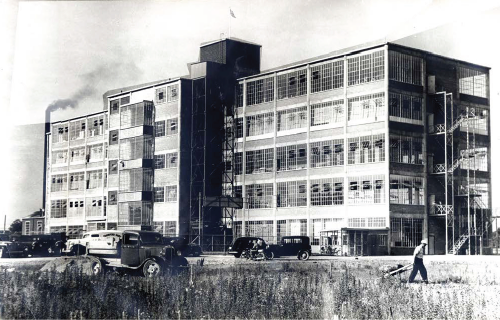
Bata Shoe Factory, 1941, Batawa, ON. Image courtesy of Batawa Development Corporation
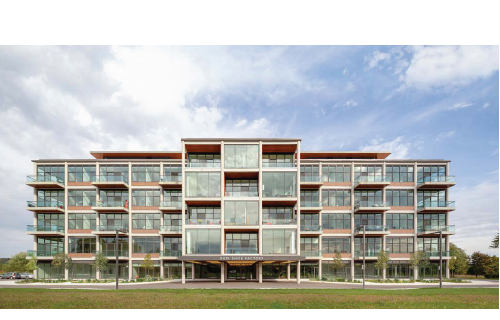
Bata Shoe Factory Lofts, Batawa, ON. Photo credit: Scott Norsworthy
Unique and Appealing Properties of Older Developments
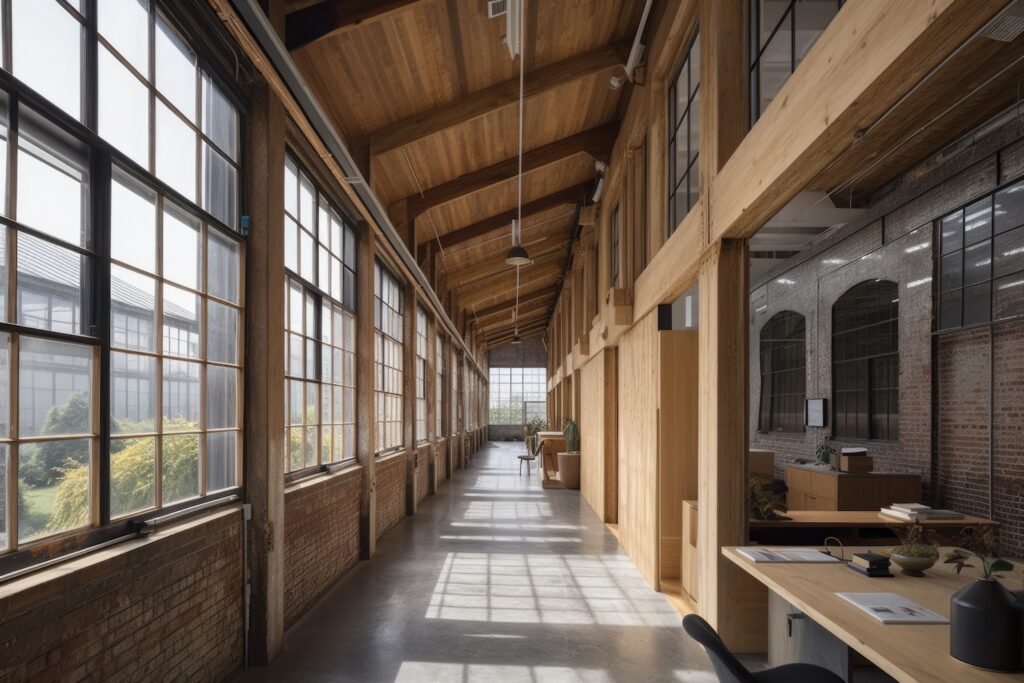
Old factories have “tall ceilings and big spans, because they needed that space,” says Heather Dubbeldam, Principal, DUBBELDAM Inc. Architecture + Design and a collaborating architect on the Bata Shoe Factory project. “We don’t build things like that anymore.”
Old factories have tall ceilings and big spans… we don’t build
things like that anymore
“They create just spectacular spaces that are not typical with new construction,” adds Dev Mehta, Principal of BDP Quadrangle and architect of record on the project.
The aesthetic potential, or rather the lack of it, may be a factor holding back the adaptive reuse of more recently-built commercial and retail space. ”Aesthetically, they’re not great,” says Sugden. “They’re ugly.”
But it’s not just aesthetics that’s driving the adaptive reuse market.
A Strong Environmental Argument
“The greenest building is the one that’s already built,” says Deeter Schurig, President and CEO of cSPACE Projects, a developer of multi-tenant creative hubs for the arts and culture sector in Calgary. cSPACE King Edward is the organization’s first project.
The greenest building is the one that’s already built
Existing buildings hold embodied energy – the energy generated to put them up in the first place. In their winning submission to the 2020 Canadian Green Building Awards, Mehta and Dubbeldam estimated that by preserving 5,200 m3 of concrete from the original structure, the adaptive reuse of the Bata Shoe factory saved some 2 million kg of CO2 emissions. They also avoided the environmental cost of knocking a building down and then putting up a new one in its place.
“The environmental impact of demolishing all of this concrete would just be devastating,” says Mehta, referring not just to the Bata shoe factory, but to the national inventory of underused industrial, retail and commercial space. “To rebuild would be environmentally irresponsible.”
Not necessarily, Sugden counters. Embodied energy that is not being put to productive use, because the structure is no longer structurally or economically viable, is “in purgatory until a better use can come along,” he says. If that better use is a vibrant community of mixed densities, then there may be a net environmental and social benefit to be earned even if it means knocking down the existing structure.
Adaptive Reuse and Neighbourhood Revitalization
Old abandoned factories and warehouses, underutilized strip plazas, shopping malls and big box stores are often found in blighted neighbourhoods. Sugden instead makes the case for adaptive reuse or complete redevelopment as a key component of neighbourhood revitalization.
adaptive reuse or complete redevelopment (is) a key componentof neighbourhood revitalization
“These are huge tracts of land, either in the core, the fringe areas of the core or in suburban areas,” he says. But it’s the downtown factories that have caught the eye of municipal and provincial politicians. They’ve eagerly ushered in rezoning and official plan amendments that have supported the adaptation and reuse of those structures. Moribund commercial space on less valuable land, more distant from transit, has not received the same attention, he says.
That’s not to say that the adaptive reuse of commercial and retail space never happens in Canada. Sugden cites a couple of examples of projects he has worked on. But it’s not the norm, he says. If a developer is willing to put in the effort to have a tract of land rezoned for a mixed-use development, that developer is likely to want to knock the building down and build something that integrates seamlessly into the new development. It makes business sense, says Sugden.
The Business Case
Kerstens says the opposite applies to old industrial land, and commercial lenders are coming around. Lenders’ poor appetite for risk may once have discouraged this type of investment, says Kerstens, but when you’re talking about a purchase at 15% of replacement value, the conversation changes.
Contamination was once a “kiss of death” for lenders… That’s no longer the case
Contamination, even the hint of it, was once a “kiss of death” for lenders, he says. That’s no longer the case. Forge & Foster has met with success adapting old industrial land in Hamilton, where “90% of our lands were contaminated from one use or another back in the glory days,” he says. He credits advances in remediation technology. Usually you can pinpoint the source contaminant, know what it’s doing and implement risk mitigation measures that will work.
Banks and other investors have realized that there are effective ways to manage contaminants with the result that there is no harm to human health. The goal is “managing the risk as opposed to eliminating the risk altogether,” says Kerstens. “You can’t cut corners on the due diligence,” he adds. “If the words ‘data gap’ are in a Phase 2, the bank is going to walk away.”
“There’s so much value in residential redevelopment that a developer will go through a full site remediation if they know they’re going to get a return on their investment,” says Sugden. He expects most developers will assume need for a full site remediation as part of their pro forma.
Spectacular Results Support Viability
While adaptive reuse takes innovation and planning, the results can be spectacular. Kerstens refers to an old Stelco building in downtown Hamilton, now part of the West Hamilton Innovation District and home to a brewery, a drone manufacturer and, soon, a medical research facility. “The clear space that exists in these products is a commodity for a lot of these groups, specifically this drone robotics company,” he says.
In Calgary, the old King Edward School had been vacant for about a decade, says Schurig. Two previous efforts to redevelop the school and its 3-acre site had failed, one because of community opposition, the other because of changed market conditions. Then cSPACE Calgary invested a year in local outreach which helped convince the community to buy into its proposal, which included the reuse of the school, public space and two new private developments. (The private developments also helped offset the project’s $35 million cost.)
cSPACE Calgary invested a year in local outreach which helped convince the community to buy into its proposal
In rural Batawa, the white elephant shoe factory, once a white elephant itself, is once more the centre of that small community. In addition to 47 high-quality residences, the building houses a daycare, an outdoor playground, community space, multi-purpose rooms, ground-floor retail space and an accessible rooftop terrace. A geothermal field of 63 holes drilled to a depth of 600 feet supplies all of the building’s HVAC needs.
The Future of Adaptive Reuse
Mehta expects consideration of adaptive reuse will at some point be a requirement. He argues that we can’t continue putting buildings up and then knocking them down every 35 years. Adaptive Reuse has been so successful that Dubbeldam wonders if we may soon run out of inventory. There are only so many old factories.
But Mehta has his eye on Canada’s large inventory of ugly strip malls, windowless shopping malls, even above- and below-ground parking lots as new frontiers of innovative real estate development opportunity.
Sugden calls them ugly, but if adaptive reuse has shown us anything, it’s that transformation is indeed possible, and they may yet find their way onto the adaptive reuse market.
“Depending on the type of space, the right architect can work wonders,” he concedes.
Depending on the type of space, the right architect can work wonders
They are not attractive, and they may not have been built to survive the ages, but “they’re all concrete buildings, which can last 150 years,” Mehta says. And with the right innovative approach, some surely will.