Jeff Goldman has a line that’s almost worthy of the comedy club circuit act.
“Pretty much all excess soil management in Ontario is controlled by one person,” he’s been telling workshop and conference audiences across the province. “He’s the most important person in the entire construction industry, and his name is Guy. Ask anyone involved in soil movement, and they’ll tell you, ‘I know a guy…‘”
Transforming Soil Management
The Ontario government is putting “Guy” out of business, and Goldman, Principal and Corporate Director of the soil management software company SoilFLO, says it’s about time. A new regulation, the On-Site and Excess Soil Management Regulation (O. Reg. 406/19), being phased in over the 2021-2025 period, will fundamentally transform the soil management industry, requiring a slew of changes including the registration of generating and receiving sites, strict soil characterization by qualified persons, accountability by designated project leaders and the tracking of soil movement from source to destination. Once the regulation is fully in effect, “Guy” will be looking for a new line of work.
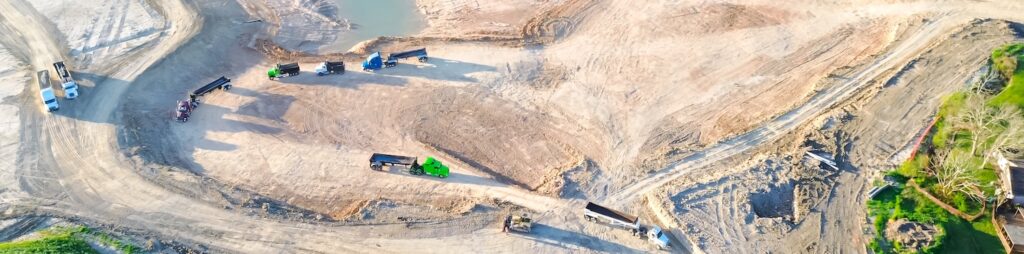
It’s a massive problem. The Ontario government estimates that some 25 million cubic metres of excess soil are generated every year – dirt from everything from basement excavations to subway tunnels. All that material has to go somewhere, and that means moving it by the truckload, snarling traffic, making noise, stirring up dust and belching emissions into the air. And though much of that soil can be safely reused elsewhere, a lot of it isn’t. Landfills have been the go-to option for many builders, but the Ontario Waste Management Association estimates that at current rates, Ontario will run out of landfill capacity by 2032, sooner if the US were to prohibit waste imports. Another undesirable option, the stuff of newspaper headlines, is illegal dumping, and stories are legion of unsuspecting landowners finding their properties used as unauthorized dumpsites, altering the landscape, changing drainage and contaminating land and water.
At current rates, Ontario will run out of landfill capacity by 2032
Goldman says that for too long, the movement of excess soil has been treated as a cost of doing business, a line item on a pro-forma. “It’s a pain in the rear,” he says. “It’s something I have to get rid of.”
Seeing Soil as a Valued Resource
That will change, says Chris Tenaglia, Managing Director of Environmental at N1 Solutions Inc., a business services provider headquartered in Sault Ste. Marie, Ontario. In highly developed regions of the province like southern Ontario, there’s not much prime development land left.
Developers are looking at sites that need soil to bring them up to grade. “I see excess soil becoming more of a commodity,” he says. “I think of soil now as a resource that we really don’t quite understand.”
I see excess soil becoming more of a commodity.
If it’s a resource, then you would expect the private sector to step up to exploit it. Two companies, DirtMarket and Fillmaps, are already active in the excess soil market in Ontario. A third, GetSoils, is still nominally operational but for now not actively soliciting business. All three are positioned as open, transparent marketplaces for soil generators and receivers, a Tinder for dirt.
On the surface, these services seem to make sense. Fillmaps founder Andrew Eldebs, who has spent his career in land development, says finding sites for soil is often one of the largest challenges faced on a construction project. But GetSoils founder Daniel Olshansky tells a frustrating tale of enthusiastic response from builders to the idea of an open marketplace for soil, but simultaneous hidebound resistance to taking part in one.
“Everybody wants a marketplace where you can go and see what soil everybody else has, but no one wants to post their own soil needs,” says Olshansky. “They want to know everything, but they don’t want to share anything.”
They want to know everything, but they don’t want to share anything
New Regulations Already in Place
Eldebs and DirtMarket CEO Emma Kirwin both say their startups are doing well, but concede that there remain significant pockets of resistance within an industry that seldom embraces change. But non-transparency simply isn’t an option anymore, Eldebs counters.
That’s thanks to Ontario’s On-Site and Excess Soil Management Regulation, which was originally to be phased in beginning July 1, 2020 but was delayed until January 1, 2021 because of COVID. Since that date, the project leader, defined in the regulation as “the person or persons who are ultimately responsible for making decisions relating to the planning and implementation of the project,” has been under an obligation to have a qualified person (QP) characterize soil at the generating site and to export it to a willing receiving site. The extent of industry compliance with even those requirements is uncertain. Ministry of Environment, Conservation and Parks spokesperson Gary Wheeler says the ministry has been focusing on outreach to heavy duty soil haulage vehicle operators in York Region, Durham Region and Peterborough since July 2021. As of October 18, 2021, it had not issued any warnings, notices of violation or tickets.
An obligation to have a qualified person (QP) characterize soil at the generating site and to export it to a willing receiving site
More Requirements on the Way
Come January 1, 2022, the building industry will face a slew of new, even more specific obligations. Before removing excess soil from a site, the project leader at a generating site (other than a low-risk or small-volume site) will be required to post a detailed notice and attestation on a public site registry that is now in the final stages of testing. That requirement will trigger a long list of additional obligations: a QP will have to be retained; testing will be required; reports will have to be prepared. There are exceptions, and the compliance obligation falls ultimately on the project leader’s shoulders.
The compliance obligation falls ultimately on the project leader’s shoulders
Reuse sites and interim sites will also have to register on the site registry, and once soil is loaded onto a truck, its movement from the generating site to the interim or reuse site or landfill will have to be tracked, creating a chain of custody for all excess soil in the province that conclusively demonstrates that soil being deposited is appropriate for the receiving site.
And new regulatory requirements don’t stop there. Beginning January 1, 2025, all excess soil that meets reuse standards will have to be reused. Landfills will be banned from accepting reusable soil except for quantities needed for maintenance, such as cover, roads or berms.
More Work for QPs, Cost Concerns
Talia Gordner, Partner at McMillan LLP in Toronto, says there’s nothing new in the obligation to deposit soil at a willing host site and to ensure that it is appropriate for that site.
What’s new is the obligation to be able to demonstrate it through a series of reports and studies and other documents.
“It changes the way you do things and the way things are recorded and sampled, but it doesn’t change the concept of reusing excess soil,” says Gordner. However, it is going to mean a lot more work for QPs, and likely higher costs for the construction industry.
Tenaglia is one of those QPs. He supports the spirit of the new excess soil regulation, but he doesn’t believe the economic impact has been sufficiently thought out.
Soil management can represent 14% or more of a project’s cost
He wonders about small businesses that do driveways, dig swimming pools, even companies that develop subdivisions. Those sectors will really feel the impact of the regulation, he says. But the regulation does provide exceptions for small quantities. The driveway and swimming pool will likely sidestep the most onerous provisions. And not everyone is convinced that compliance will be a net cost to builders. Soil management can represent 14% or more of a project’s cost. Advance planning for excess soil management is a good idea, period, Goldman says. Ultimately, it will lower costs, not raise them, he believes.
Resistance and Concerns
Both Eldebs and Kirwin agree that a properly functioning market for soil will ultimately lower the cost of transportation and disposal. What’s still uncertain is whether that saving will be eaten up by regulatory costs – the registration fees and characterization studies that the regulation requires.
Another source of resistance is found in the nature of the construction industry itself. Goldman describes soil movement in Ontario as a billion dollar industry managed by a three-part ticket system.
A billion dollar industry managed by a three-part ticket system
“The construction industry, especially residential, is a family-centric business. With that, there is a certain resistance to change,” he says. “It’s all landlines and Rolodexes.”
It’s a very competitive, hard-working industry, accustomed to doing things a certain way, Kirwin charitably explains. Her pitch is that her company, DirtMarket, will save them time and money, and that the learning curve is not steep.
“I expect that when this next phase of regulations rolls out there will be a lot of questions and a lot of confusion,” says Goldman, even despite the many efforts of industry associations, the province, law firms and consultants to educate the marketplace over the past year through countless publications, blogs and webinars.
Soil Registry Ahead of Schedule
Ontario’s Resource Productivity & Recovery Authority has been charged with building the excess soil registry, and it is on schedule to go live ahead of its January 1, 2022 formal launch date, says Ellen White, Manager of Communications and Stakeholder Relations. It has consulted with an industry advisory group and has conducted industry outreach to a list provided by the Ministry of Environment, Conservation and Parks, to industry organizations, and through social media. Right now, it is in the midst of a consultation effort with industry on fees. White says a training program on the new registry will launch later in November. The industry may not like it, but it will have to adapt, and Jeff Goldman, if he has designs on Just for Laughs, may have to write some new material.