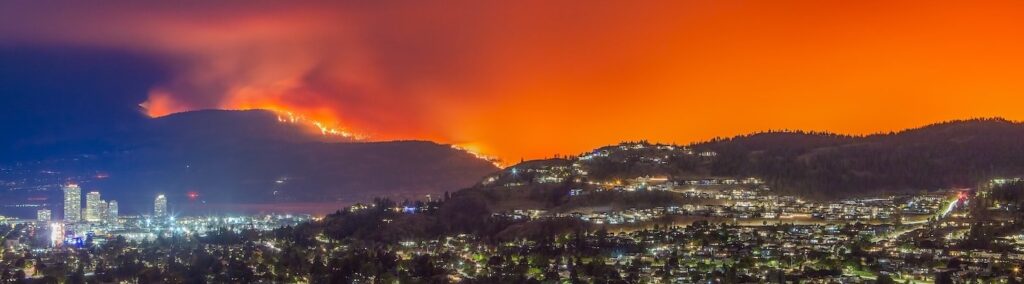
Wildfire risks are escalating in Canada due to climate change, outdated policies, and lagging adaptation efforts. Because temperatures have been rising faster at high northern latitudes and over land rather than oceans, Canada is warming twice as fast as the global average. Experts predict Canada will experience longer fire seasons, larger and more intense fire events, and extreme fire weather, increasing risk to people, communities, and businesses in forested areas.
Canada is warming TWICE AS FAST AS THE GLOBAL AVERAGE.
Canada is already experiencing intense wildfire events. The 2016 wildfire in Fort McMurray, Alberta, cost approximately $9 billion in direct and indirect physical, financial, health, and environmental impacts. It also triggered the largest evacuation in Canadian history, with more than 2,400 structures destroyed and 85,000 people displaced. The 2023 wildfires in Quebec caused economic losses of more than $8 billion. It was the most destructive wildfire season on record in Quebec. The 2024 Jasper wildfire caused $880 million in insured losses, destroying or severely damaging over one-third of the town and forcing 25,000 people to evacuate, and Ontario saw its largest-ever wildfire in the summer of 2025.
Why Consultants Should Consider Wildfire Risk
These large-scale wildfire events destroy communities, drive up insurance costs, and threaten economic security. The cost of wildfire protection has also risen by about $150 million per decade since the 1970s, exceeding $1 billion for six of the last 10 years. Both wildfire prevention and remediation costs should be significant factors in the due diligence process.
These large-scale wildfire events destroy communities, DRIVE UP INSURANCE COSTS, AND THREATEN ECONOMIC SECURITY.
Environmental contamination from wildfires is another challenge. In northern Canada, particularly where historical mining activities have occurred, wildfires burning through peatlands can release pollutants, such as mercury and arsenic, trapped for decades or even centuries in the soil. These metals can become airborne and travel long distances, creating liability risks and increasing cleanup costs.
When it comes to property redevelopment, wildfires lead to a host of building challenges. For example, labor shortages have delayed redevelopment after wildfire losses. Other issues include lengthy permitting processes, short construction seasons because of winter weather, and logistical challenges in remote areas.
These risks and challenges underscore why consultants should consider wildfire impacts during due diligence. Evaluating wildfire risk early in site assessment and redevelopment planning can help identify potential issues, minimize unexpected costs, and support more resilient project outcomes.
Evaluating wildfire risk early in site assessment and redevelopment planning can help IDENTIFY POTENTIAL ISSUES, MINIMIZE UNEXPECTED COSTS, AND SUPPORT MORE RESILIENT PROJECT OUTCOMES.
Expanding Environmental Site Assessments
Canada, like the United States, is increasingly interested in climate risk assessments. CSA Z768-01 (R2022) is the go-to standard for Phase I environmental site assessments in Canada. Like ASTM E1527-21 in the U.S., CSA Z768-01 does not explicitly identify wildfires or other natural disasters as “recognized environmental conditions” (RECs) requiring investigation. But consultants are increasingly incorporating wildfire-related contamination as a site-specific environmental concern in high-risk regions.
In fact, real estate industry best practices are shifting to include consideration of wildfires and other physical climate hazards, ClimateCheck Principal Cal Inman said during a recent webinar.
Emergency Response & Remediation
When wildfire emergencies happen in Canada, they are managed first at the local and then at the provincial or territorial level. The federal government is available for additional support.
Public Safety Canada coordinates federal disaster recovery through Disaster Financial Assistance Arrangements (DFAA), which reimburse provinces for eligible debris management and cleanup after declared disasters. Provinces and territories lead wildfire response and environmental cleanup through their own emergency programs, often supported by local contractors and public health units.
Canadian wildfire cleanup follows a risk-based, standards-driven framework. The National Collaborating Centre for Environmental Health provides core guidance on ash management, re-entry, debris segregation, and worker safety. Cleanup verification relies on CCME Environmental Quality Guidelines for soil and water, while hazardous debris must be managed under CEPA and Transport of Dangerous Goods requirements.
British Columbia
British Columbia provides the most comprehensive example of wildfire debris and hazardous materials management at the provincial level. For example, the province’s Ministry of Environment and Climate Change Strategy has post-wildfire guidance for handling hazardous materials. That guidance:
- Discusses how urban fires pose significant environmental hazards to water sources, roadways, recreational areas, and communities.
- Assists communities in managing the immediate and long-term environmental risks associated with wildfires.
- Advises on the performance of environmental assessments to ensure the safe removal, storage, and containment of environmental hazards.
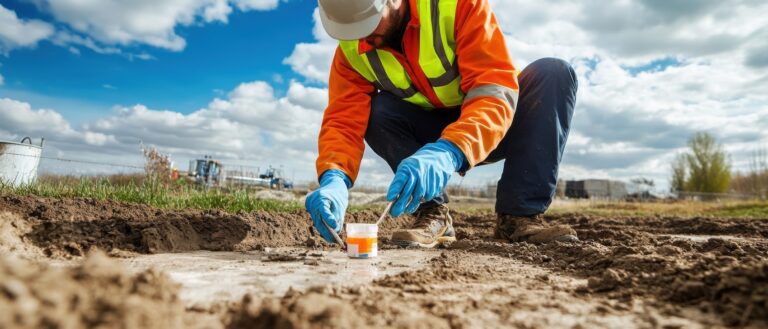
- Explains how environmental sampling and monitoring are essential for characterizing the impacts of wildfires on soil and groundwater, and how sampling and monitoring programs should be designed and executed under the guidance of a qualified professional.
- Notes that wildfire ash can contain hazardous materials, like heavy metals, asbestos, and hydrocarbons, and that it’s important to dispose of ash properly to mitigate its short- and long-term effects.
Additionally, BC’s Wildfire Land-Based Recovery program is intended to reduce the negative impacts of wildfires, including reductions in timber value and economic opportunities.
Quebec & Ontario
Quebec applies its Guide d’intervention – Protection des sols et réhabilitation des terrains contaminés to fire-damaged lands, establishing soil-screening levels and cleanup procedures. The Règlement sur les matières dangereuses governs the handling, transport, and disposal of hazardous materials, complementing post-wildfire remediation work. Ontario integrates existing asbestos and hazardous-waste regulations into its wildfire cleanup processes, supplemented by public-health guidance on smoke exposure and air quality during recovery.
Keep in mind that Canada does not have a dedicated federal or provincial funding program for wildfire-related environmental remediation of commercial sites. Costs are generally borne by property owners, insurers, or through limited provincial cost-sharing under DFAA. Quebec has offered short-term business recovery assistance (e.g., a $50 million fund following the 2023 wildfires), but this did not include funding for environmental cleanup.
Resilience & Adaptation
Canadian wildfire resilience involves federal programs such as the Wildfire Resilient Futures Initiative (WRFI), launched by Natural Resources Canada in 2023. This initiative, part of the Government of Canada Adaptation Action Plan, is funding up to $285 million in new programs to reduce wildland fire risk over five years. The program supports research, community adaptation, and risk-reduction planning to complement on-the-ground cleanup and redevelopment efforts. However, while Canada is committed to reducing wildfire risk, Canada’s National Building Code does not include any explicit wildfire-related provisions.
There isn’t a one-size-fits-all approach to mitigating wildfire risk across Canada’s diverse landscape. Wildfire resilience varies from community to community. For example, British Columbia’s FireSmart program is a provincial initiative aimed at reducing the risk of wildfire damage to homes, communities, and forests. Its Wildfire Mitigation Program Assessment highlights specific actions property owners can take to reduce wildfire risk.
There ISN’T A ONE-SIZE-FITS-ALL APPROACH to mitigating wildfire risk across Canada’s diverse landscape. Wildfire resilience varies from community to community.
Other approaches include Ottawa, which launched the Wildfire Resilience Consortium of Canada to strengthen wildfire science, forecasting, and training, and Quebec, which offers limited wildfire adaptation strategies.
After the devastating 2024 fire in Jasper, Parks Canada introduced stricter development regulations for the town. There is now a ban on wood siding and roofing, as well as mandatory buffer zones of nonflammable materials around homes. But Jasper still needs to update its zoning regulations to better manage wildfire risk.
Jasper’s distinct governance structure also makes managing wildfire risk more complex. It’s a town within a national park, and while the city handles local services like utilities and social programs, Parks Canada was responsible for land-use planning and forest management. But the federal government passed new legislation after the 2024 wildfire, transferring land-use planning and development authority to Jasper to expedite rebuilding efforts.
Integrating Wildfire Risk into Practice
While there have been minimal long-term shifts in policy or development practices after wildfires, efforts are underway to strengthen policies and building codes at the provincial and federal levels. Consultants who track these developments and integrate wildfire risk into environmental due diligence and redevelopment planning will be better positioned as expectations and regulatory requirements evolve. Taking these steps now will help advance safer, more sustainable redevelopment in wildfire-prone regions.


Mary Ann Grena Manley
Founder and President of 15E Communications LLC, Washington, DC
Mary Ann is the Founder and President of 15E Communications LLC, a Washington, DC-based consulting firm that assists clients with communications strategy, content, business development, and public relations. Prior to founding 15E in 2020, Mary Ann managed Bloomberg Industry Group’s coverage and analysis of global environment, health, safety, and sustainability issues for more than 20 years. With experiences cutting across environmental law, policy analysis, journalism, and marketing, she most recently served as Deputy Editorial Director for Bloomberg Environment. Her areas of policy expertise include environmental compliance, environmental due diligence, risk management, brownfields redevelopment, and sustainability. Connect with Mary Ann via email, or through LinkedIn.