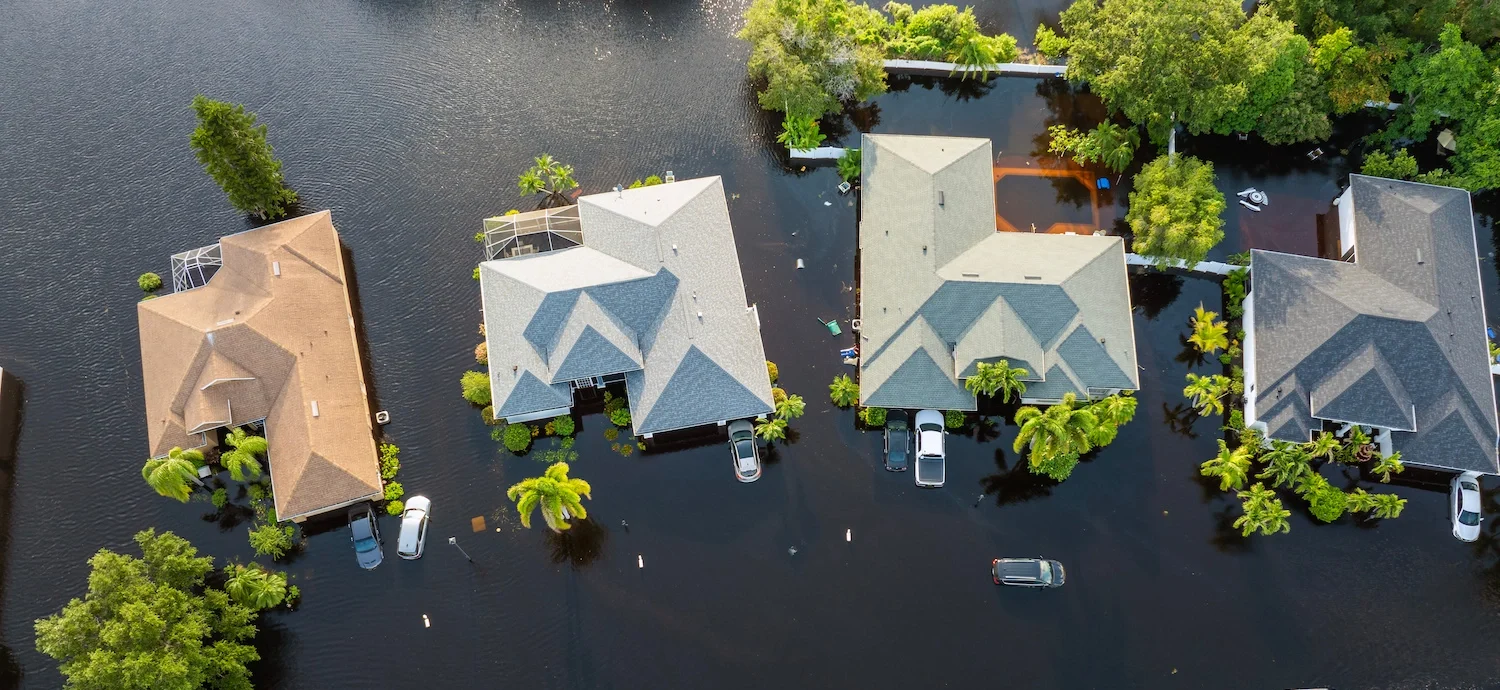
Already the most common natural disaster in the United States, climate-related flooding is increasing, even where floods previously were rare. While this causes great concern for developers, lenders and (especially) insurers, the complex science and the murky regulatory landscape mean serious challenges for consultants.
In 2016, global economic losses resulting from flooding totalled over $56 billion dollars. Floods have brought destruction to every state and almost every county in the U.S, and have had similar impacts in other countries.
Though coastal areas take some of the most dramatic damage as a consequence of rising sea levels and storm surge, inland areas are also experiencing more flooding from uncommonly heavy rainfall during storms. According to a recent study, approximately 41 million U.S. residents are at risk from flooding along rivers and streams.
As devastating as it can be, floods do even more than damage buildings. They can also cause contamination. For environmental consultants, this makes flood risk one of the most challenging—and important—parts of due diligence work.
The inside baseball of 1990s technical climate discussions have yielded in recent years to alarming weather incidents that hint at what our world might look like soon. While extreme weather events appear to be happening almost everywhere, some of the most dramatic are occurring in less populated territories close to the North and South Poles. Examples include this year’s extraordinary wildfires in Australia, melting Arctic permafrost, and the record snowfall in Newfoundland and Labrador (where the army was called to help dig out from a record-breaking blizzard that dumped more than 70 cm [27 inches] of snow).
Flood Plains & the Redevelopment Industry
Real estate developers may not possess the magic bullet technology of a Heliogen (see box), but industry leaders are investigating what they can do to reduce emissions from their operations and to mitigate against climate change’s anticipated impacts.
“Emissions reductions can stem from as simple a thing as buying cement from the nearest plant,” says Matthew Gardner, a partner in Canadian law firm Willms & Shier. “This reduces truck transportation and the associated emissions.”
Sometimes the bad news drowns out EMERGING SOLUTIONS
For instance, how many people were lucky enough to stumble upon this fascinating news item on CNN Business, which describes a clean-energy startup — called Heliogen — that owns patents to a disruptive solar technology. Essentially, smart software concentrates sunlight from thousands of reflective mirrors into a single beam, achieving extreme heat levels of around 1,000 degrees Celsius (about a quarter the temperature of the Sun’s surface). This “solar oven” will allow for the production of concrete and steel without coal and other fossil fuels.
Insurers, Developers, and Lenders on Edge
An area of concern to consultants and developers of brownfields and other kinds of old commercial or industrial sites is flood plains. Simply put, increased extreme weather events are causing flood incidents more often, with some jurisdictions experiencing once-in-a-century floods every few decades, or even every few years. The potential disruption and devastation to developments in low-lying areas, therefore, is of concern to developers, lenders and (especially) insurers. But things are in flux.
Brian Zink started in the due diligence field in 1998 and joined Baltimore, Maryland-based Bureau Veritas as a senior environmental consultant in 2003. His experience helping developers anticipate environmental problems has brought the climate change and flood plain issue to his attention.
“Within the last few years I’ve had friends in Florida and other parts of the country say there have been more hurricanes, more evacuation incidents, where they never needed to evacuate before,” says Zink. “What drove it home finally was when my family in Houston, who live in a flood plain, experienced their house flooding twice in the last four years.”
“The second time it flooded there was three to four feet of water in their house,” says Zink. “They weren’t ready for that.”
How FEMA Is Reacting
Low-lying areas are flooding, and rivers are bursting their banks every few years where construction anticipated such incidents only once per century or less. According to Zink, the US government has changed its internal policies in regard to flood plains.
“FEMA (the Federal Emergency Management Agency) is a lot slower in issuing money to sites in flood plains or in granting insurance to such sites,” Zink says, adding they’re the subject of close scrutiny.
“More of my due diligence work these days relates to areas where a flood or similar natural disaster could impact a property,” he states.
AFPM Developing Floodplains Criteria?
Asked whether the American Fuel and Petrochemical Manufacturers (AFPM) will add criteria and protocols for its members in anticipation of climate-related flooding and fires, Zink says it’s likely.
“The AFPM already covers a range of other issues,” says Zink. “It wouldn’t surprise me if there’s eventually a push for the AFPM to develop more criteria for evaluating climate change indicators, in addition to what they might have already.”
Zink believes the AFPM may already have criteria for evaluating floodplains and wetlands, but its libraries are extensive. If a consultant isn’t working with AFPM criteria almost daily, it could be difficult for them to find what they’re looking for.
“Right now there doesn’t seem to be any overarching guidance,” states Zink, who believes climate changerelated due diligence is hampered by lack of consensus in the industry about what to do.
Contamination Science is Key
“Due diligence today involves reviewing contamination data,” Zink says, “and knowing how contaminants generally spread in soils and groundwater, then evaluating the situation in terms of scientific fact, and knowledge of geology and the local terrain.”
Lack of Rules and Clarity
Climate change is more nebulous. The science is not only in flux but consulting for climate change, of any magnitude, would require looking at a much larger picture with seeming unconnected points of data impacting each other. Hence the lack of mandatory rules or incentives for developers and others to explicitly mitigate future effects.
Zink points out another challenge.
“How do you govern [climate change] nationally when a lot of the problems are going to be very local?” he asks. “You know you’re not going to have hurricanes in Michigan. Do we want Michigan residents having to abide by hurricane impact rules?
“Regulations and guidelines need to be developed regionally or at the state level,” Zink says, adding that he’d nevertheless welcome the federal government entering the fray in a similar manner to its approach in regard to coastal zone management. (With coastal zones, the federal government created overarching criteria and then demanded of states that they prove they’re dealing with the challenges in terms of that criteria.)
“This gives local governments and states some agency in how they approach these things,” Zink says. “They’re the most knowledgeable about the local economic and environmental situation, and the needs of citizens.”
He mentions some people are content to live in hurricane zones as long as they have the right window shutters and have appropriate disaster insurance. But not everyone is prepared, in which case states are better equipped to serve local needs than the federal government.
Asked whether there might ever be a “Superfund”-style program with money allocated towards mitigation of climate change effects, Zink agrees there could be, eventually.
“I think it comes down to the legality,” Zink says, especially if people feel they have no-one to turn to but the federal government.
“States like Louisiana and California which have been hard hit in the past are likely to create state-level funds, especially if they determine it’s more costly not to do so.”
Flood-Related Due Diligence Needs
“More of my due diligence work these days relates to areas where a flood or similar natural disaster could impact a property,” says Zink.
The need for environmental consultants to sharpen their f lood-related due diligence skills is clear. This certainly looks like a growing field of expertise. Equally important is the need for new regulations and guidelines at every level of government and industry, but those guidelines may be slow to come.
ERIS’ Physical Setting Report (PSR) provides comprehensive information about the physical setting surrounding a site, including key hydrologic and water table characteristics, and the most recent FEMA Flood Hazard Zone Map available. For full analysis, the PSR also provides a complete overview of topography, surface topology, geology, and soil information. The location and detailed attributes of oil and gas wells, water wells, public water systems and radon are also included. ERIS’ PSR is available for large corridors and custom areas. The best part, PSR is available within ERIS Xplorer to allow interactive layering and analysis over aerials, topographic and Google map base layers.


Guy Crittenden
Content Developer for ERIS, Toronto, Ontario

Tina Cressia-Thomas
Research Journalist for ERIS, Monterrey, California