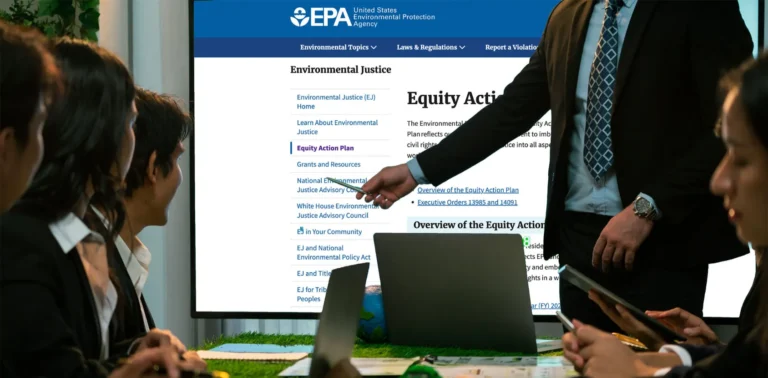
Today, artificial intelligence (AI) is rapidly advancing, becoming a powerful tool for a number of important tasks including identifying operational efficiencies, predicting environmental risks, and supporting businesses and policymakers in optimizing resource allocation. The emergence of augmented reality and its potential impact on environmental and CRE industries is also becoming more relevant to the field.
Environmental AI on the World Stage
On a global level, the United Nations (UN) has recognized AI as an important tool to evaluate and address climate change. The UN Environment Programme’s World Environment Situation Room (WESR) illustrates how AI can be used in this context. The WESR leverages AI to curate, aggregate, and visualize earth observations and sensor data in near real-time. This includes CO2 atmospheric concentrations, glacier mass changes, and sea-level rise data. The goal here is to create a mission control center for the planet to support data-driven decisions.
The International Methane Emissions Observatory, a part of WESR, also uses AI to monitor and mitigate methane emissions. It offers a global public database that connects empirically verified methane emissions data with scientific research and policy recommendations, helping leaders make data-driven decisions. This is another example of the power of AI in data collection and analysis and its pivotal role in global sustainability efforts.
The United Nations (UN) has RECOGNIZED AI AS AN IMPORTANT TOOL to evaluate and address climate change.
AI and Commercial Real Estate
Any business that uses data can benefit from artificial intelligence, including the real estate industry. For example, AI algorithms can generate more precise property valuations by analyzing historical sales data, current market trends, prices of comparable properties, and other variables. AI can also be used for flood prediction and management, to create 3D property models, and to analyze borrower information.
Additionally, AI applications are quickly reshaping the commercial real estate landscape by optimizing energy efficient smart buildings and using predictive analytics. Integrating AI with building systems can increase operational efficiency, better utilize resources, improve occupant experience, and even incorporate renewable energy sources into electrical grids. AI-powered smart buildings automate various functions — like using occupancy sensors to control temperature and lighting — and continuously collect data, ensuring that the system is constantly learning and pursuing peak efficiency.
Integrating AI with building systems can INCREASE OPERATIONAL EFFICIENCY.
AI Can Help Reduce Emissions, Navigate Regulations
Similar to TRC (featured in the opposite column to the right) ERM’s OPEX Group and Libryo acquisitions demonstrate how AI can reduce emissions and navigate complex environmental regulations. OPEX is a specialty software company that uses AI solutions to help customers maximize their efficiency and minimize their carbon footprint. Libryo is a global EHS regulatory intelligence platform that helps organizations manage their varying legal requirements based on jurisdiction. While smart buildings are used throughout the CRE market, they could be especially beneficial for data centers. The global data center market is growing rapidly, with the number of hyperscale sites in development expected to double by 2024. That exponential growth and a constrained power supply emphasize the need for more energy-efficient buildings in the real estate sector.
Because AI quickly analyzes vast amounts of data like historical sales information and other economic factors, it can predict CRE industry trends and patterns and provide detailed analytics on properties and markets. This helps owners, investors, buyers, and sellers minimize risk and make the most informed, data-driven decisions possible.
How One Business is Using AI InnovationBusinesses are already harnessing AI to drive environmental and operational improvements. For example, TRC’s Digital initiative combines AI, blockchain, and cloud technologies to provide real-time insights for construction, design, and environmental regulatory data reporting via three distinct platforms:
- Connected SmartSites: This platform enhances construction, design, and program management projects. It aims to improve cost and schedule predictability by providing real-time insights, offering clients greater confidence in project outcomes.
- Connected FieldForward: Designed to streamline land, survey, and engineering field services, this platform leverages digitization and technology to enhance efficiency. Its ultimate goal is to ensure a higher level of certainty in project execution.
- Connected EnviroView: This platform addresses environmental regulatory data management. Through tech-enabled processes, it enhances the accuracy and speed of reporting, uncovering valuable trends in regulatory data for clients.
AI Advances Drone Technology
AI algorithms have made it possible for another emerging tech — drones — to become even more versatile, efficient, and accurate. Aerial imagery collected from drones is increasingly used in commercial real estate property assessments. Drones can easily observe roof conditions and other property features, providing more accurate data in the assessment process. They have also been used for monitoring environmental remedies or institutional controls to ensure their integrity and fulfill regulatory compliance obligations. The use of drones for environmental site assessments proliferated during the pandemic, and the industry has advanced exponentially, expanding applications for more widespread use.
To that end, ASTM International’s Subcommittee E50.02 on Real Estate Assessment and Management is developing standard guidance “for the capture, evaluation, and delivery of drone flight imagery for the purpose of supporting commercial real estate assessment and management objectives.” The exact scope of the standard is in the early stages of development as the committee gathers information on how the CRE industry currently utilizes drones. The finalized standard could come by the end of 2024.
AI’s role in environmental compliance assurance and enforcement CAN POTENTIALLY STREAMLINE…. COMPLEX, COSTLY, AND TIME-CONSUMING PROCESSES.
AI for Environmental Compliance, Policy, Environmental Justice
Similar to drones, AI’s role in environmental compliance assurance and enforcement can potentially streamline these otherwise complex, costly, and time-consuming processes. AI can effectively assist regulators and regulated parties with monitoring compliance through data analytics from sources like satellite imagery, drone footage, and social media.
AI also has the potential to address environmental impact disparities and to reshape the approach to environmental justice. Specifically, AI can be used for more effective and enhanced risk communication, monitoring potential environmental harms, and mitigating environmental impacts. It can also help communities access information that elevates their understanding of complex environmental issues and benefits advocacy and funding efforts.
In recent months, EPA Administrator Michael Regan has expressed the agency’s desire to “harness the power of artificial intelligence” as it engages with the private sector on critical issues, including environmental justice and climate. The private sector is already exploring how to optimize this emerging technology to improve environmental outcomes, particularly for the most vulnerable communities and populations.
Terradex, an industry pioneer in land stewardship technology for contaminated sites, explored the intersection of AI and environmental justice at EPA’s recent Brownfields 2023 Conference.
Acknowledging the importance of transparency and “guardrails” as it integrates AI into existing tech workflows, the company is leveraging natural language processing and generative AI to communicate potential site-related risks to affected communities and all stakeholders more effectively. Terradex aims to deliver timely, understandable advisories in multiple languages through this enhancement, fostering greater engagement and awareness of potential risks within impacted communities. Terradex anticipates the launch of this improved alert messaging in 2024.
Augmented Reality and Environmental Awareness
In what might be referred to as the newest emerging tech kid on the block in the environmental realm, augmented reality (AR) technology has the potential to enhance environmental awareness and education. By overlaying digital information onto the physical world, AR can provide immersive experiences that help individuals better understand climate change and environmental threats. AR can be used to monitor wildlife, combat illegal poaching, and make conservation education engaging and enjoyable.
When combined with AI, AR and virtual reality (VR) — a computer-generated environment that places users in a scene that appears to be real — offer immersive experiences that enhance understanding of and engagement with climate data. These technologies can help bridge the knowledge gap of the public’s understanding of climate change by visualizing data in compelling ways.
AR is not limited to environmental awareness; it can also play a role in real estate and energy management. By overlaying digital information onto physical building footprints, AR provides real-time insights into energy consumption, helping organizations make informed decisions to reduce waste and improve sustainability. It can also enhance safety by giving workers critical information about their surroundings.
Because THE OUTPUT IS ONLY AS GOOD AS THE INPUT, AI can generate fake or defamatory information.
Challenges: Privacy, Data Accuracy, and Emerging Technology Applications
Despite their many positive and time-saving benefits, these technological advancements also raise significant legal, ethical, and privacy concerns. Transparent, unbiased, and accountable decision-making processes are essential as these emerging technologies are integrated into business strategies and environmental practices.
The intersection of privacy and emerging tech, especially AI, raises important considerations. Lack of transparency, potential for error, and the commoditization of personal data in AI development pose ethical challenges. Balancing data privacy with the demand for extensive data usage is critical. In fact, we are already seeing regulatory scrutiny.
In July, the Federal Trade Commission (FTC) launched an investigation into ChatGPT creator OpenAI to determine whether the company violated consumer protection laws. Specifically, the FTC will determine if the company “engaged in unfair or deceptive privacy or data security practices” and if these practices harmed consumers. “Harm” includes “reputational harm.”
There are also concerns about data accuracy. Because the output is only as good as the input, AI can generate fake or defamatory information. AI tools can be used to knowingly spread false or misleading content. It will be important for AI platforms to install safeguards against these risks and for consumers to be aware of such issues. Regulatory fixes could go a long way in mitigating these accuracy concerns.
For example, the European Union’s Digital Services Act — the first comprehensive rules for AI — went into effect in August. Under the new rules, large online platforms like Google, Facebook, and Amazon are responsible for improving online safety by preventing and removing posts that contain illegal goods, services, or content. Users must also be given the means to report illegal content. Additionally, large platforms are limited in the types of targeted advertising they can do, and they must be more transparent about how their algorithms work.
Conclusion
These tech advancements offer substantial benefits in terms of efficiency, decision-making, rapid insight, and resource-saving automation. But they also come with ethical and legal considerations, especially regarding data privacy and AI’s responsible use. As we move forward, there will be much more thought around transparency, trustworthiness, impartiality, and accountability on the way to realizing the full potential of these new technologies and advancing our ability to make better, more accurate environmental decisions.


Mary Ann Grena Manley
Founder and President of 15E Communications LLC, Washington, DC
Mary Ann is the Founder and President of 15E Communications LLC, a Washington, DC-based consulting firm that assists clients with communications strategy, content, business development, and public relations. Prior to founding 15E in 2020, Mary Ann managed Bloomberg Industry Group’s coverage and analysis of global environment, health, safety, and sustainability issues for more than 20 years. With experiences cutting across environmental law, policy analysis, journalism, and marketing, she most recently served as Deputy Editorial Director for Bloomberg Environment. Her areas of policy expertise include environmental compliance, environmental due diligence, risk management, brownfields redevelopment, and sustainability. Connect with Mary Ann via email, or through LinkedIn.