Part 1 discussed the potential liabilities associated with wildfires and the importance of incorporating those risks into due diligence practices to avoid financial exposure in acquisition and redevelopment decisions.
Identifying potential wildfire risks and liabilities is only the first step. Equally critical is understanding how policy frameworks, resilience measures, and redevelopment strategies can reduce wildfire risk and support long-term recovery after a disaster.
Identifying potential wildfire risks and liabilities is ONLY THE FIRST STEP.
Wildfire-Related Policy Frameworks
Historically, federal wildfire management has focused on suppression and controlled burns. However, the devastation of urban fires, like those that wreaked havoc in Los Angeles in January 2025, has prompted some new federal wildfire prevention and response policies.
In March 2025, President Trump issued an executive order (EO 14239) directing the creation of a national resilience strategy that reallocates preparedness and resilience responsibilities from the federal government to state and local governments. Then, in June, EO 14308 consolidated wildfire management responsibilities between the Department of Agriculture and Department of the Interior into a new Wildland Fire Service. The goal is to streamline federal aid and better coordinate with local risk-mitigation efforts. However, these actions are also consistent with traditional controlled burn policies. In fact, EPA recently issued guidance promoting the use of prescribed fires as a risk mitigation tool.
Increasing Importance of Building Codes
These actions highlight the crucial role of state and local wildfire policies in wildfire mitigation. Specifically, building codes that require the use of fire-resistant building materials and establish defensible space around structures can minimize property damage, prevent fires from spreading, and help communities recover faster. These are among the most effective tools to reduce wildfire risk. But few states have incorporated wildfire resilience into their building codes.
That said, traditional building codes are increasingly incorporating green strategies, including those that address wildfire risk. Green building requirements often reference the LEED (Leadership in Energy & Environmental Design) rating system, the most widely used green building certification in the world. LEED is a holistic framework that addresses water and energy use, waste management, materials selection, and other environmental issues.
LEED v5 focuses on proactive planning and resilient design to guard against climate hazards such as wildfires. All LEED projects must now complete a climate-resilience assessment to evaluate wildfire risk and other hazards to inform the design process and integrate resilient design measures.
California, Colorado, Nevada, Pennsylvania, Oregon, and Utah have adopted wildfire-related building codes that all require the use of fire-resistant construction materials in high-risk areas. And all these state codes align with or reference LEED, except Pennsylvania, which relies on the International Energy Conservation Code, or IECC.
Summary of State Wildfire-Related Building Policies:
- California requires new and existing structures in wildland-urban interface (WUI) areas to use ignition-resistant materials, including fire-rated roofing, fire-resistant siding like stucco or fiber cement, and ember-resistant vents. However, the California Board of Forestry and Fire Protection has missed two deadlines to approve regulations implementing ember-resistant zones in wildfire-vulnerable communities. Those regulations remain in limbo, with the board set to resume work on them in March 2026.
- Colorado requires construction in WUI areas to use materials like Class A roofing, ember-resistant vents, and tempered glass windows to resist wildfire and wind-blown embers.
- Nevada’s requirements include the use of ignition-resistant construction materials in high-risk areas and buffer zones between structures and undeveloped wildland.
- Pennsylvania’s wildfire building codes mandate specific construction methods and materials for buildings in WUI areas, which include requirements for access roads, water supply, and ignition-resistant materials for exterior walls and roofs.
- Oregon requires property owners in high-risk areas to harden their buildings against wildfire risk and implement defensible space.
- Utah requires new construction in WUI areas to use ignition-resistant materials, such as Class A roofs and noncombustible exterior walls, and has specific requirements for building components such as windows, eaves, and decks.
In addition to LEED, the IECC and the International Wildland-Urban Interface Code (IWUIC) can inform best building code and green construction practices. The IECC is a model building code that sets minimum energy efficiency standards for new residential and commercial construction in the U.S., covering insulation, windows, HVAC, lighting, and other issues. The IWUIC is a model code designed specifically for wildfire risk in WUI areas where development meets wildland vegetation.
Real Estate Developers & Consultants Fill the Gap
In states without wildfire prevention requirements, real estate developers have stepped into the regulatory gap, actively working to minimize fire risk. They recognize that hazardous air quality and electricity outages caused by wildfires lead to business interruptions and increased costs for air filtration and other technologies. Wildfire damage also leads to higher insurance premiums and depressed real estate values.
Developers and their consultants increasingly rely on structured, property-level resilience assessments. ASTM’s Standard Guide for Property Resilience Assessment (E3429-24) provides a framework for evaluating wildfire exposure across site conditions and structures and for informing redevelopment and resilience investments where wildfire requirements are limited or inconsistent.
In practice, developers are protecting residential and commercial buildings through structure hardening, strategic density in lower-risk areas, and evacuation route planning. Many developers actively participate in wildfire resilience programs and educate tenants about fire-safe landscaping. Consultants can help by providing developers with crucial historical and current property data to identify potential wildfire risks and environmental liabilities.
Strategic Planning for Redevelopment
Following a major wildfire event, redevelopment planning shifts from site-level risk mitigation to coordinated recovery and rebuilding at the community scale. Strategic planning for redevelopment is essential to ensure that rebuilt structures are safer and more resilient. Investing in wildfire-resistant buildings and other resilience policies not only protects communities but can also save billions of dollars in future losses.
Strategic planning for redevelopment is essential to ensure that rebuilt structures are SAFER AND MORE RESILIENT.
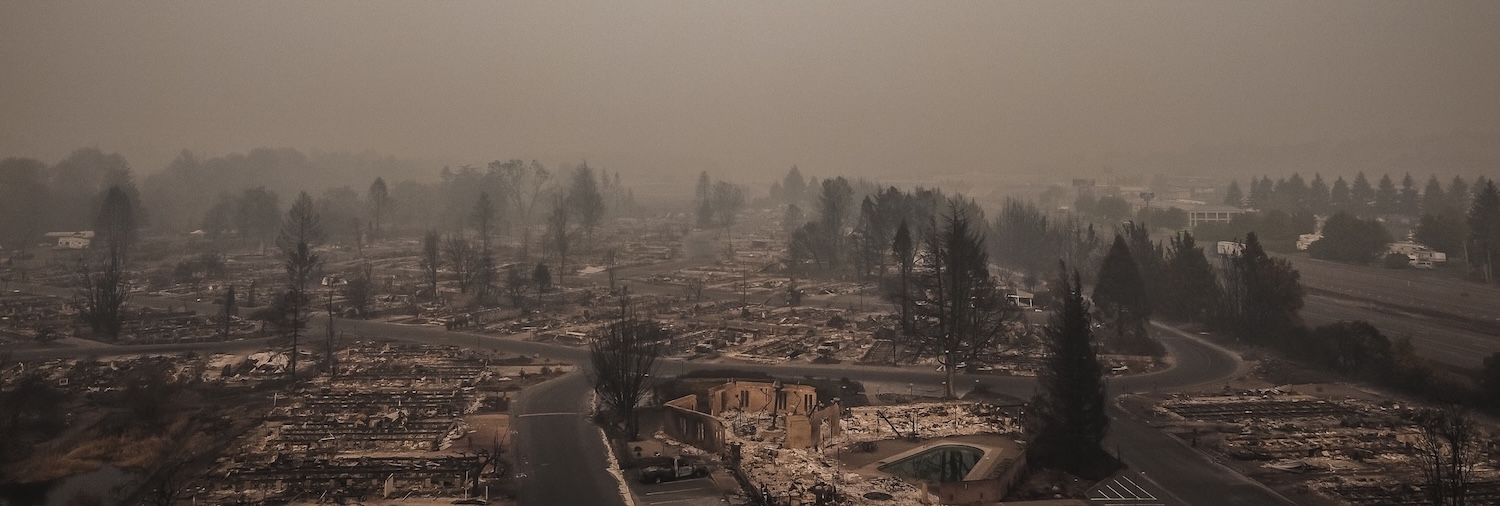
For example, following the 2017 Tubbs Fire that destroyed 5,300 homes, Sonoma County created an Office of Recovery & Resiliency to coordinate rebuilding and recovery efforts. The goal was to make the county more resilient to future wildfire disasters. To that end, county leaders invested in infrastructure improvements, vegetation management, a new alert system, and other related projects.
The 2018 Camp Fire in Paradise, California, was one of the deadliest wildfires in U.S. history, destroying more than 18,000 structures. In the aftermath, the town focused heavily on rebuilding with fire-resilient infrastructure. One of their solutions was investing in noncombustible buildings, called the Q cabin, constructed out of steel.
Other strategic redevelopment solutions include:
- standardizing debris removal protocols so that property owners can return to their buildings sooner,
- fast-tracking permitting and inspections to expedite rebuilding,
- addressing labor and supply chain issues that affect construction timelines,
- stabilizing the property insurance market to ensure continued coverage (in California, specifically, for the examples above), and
- offering mortgage forbearance to help fire victims return to their communities.
Additional best practices include prioritizing community engagement and incorporating wildfire-resilient vegetation and land-use management practices.
Cleanup is also an important part of the redevelopment process. Keep in mind that wildfire cleanup isn’t just about removing burnt structures and vegetation. Many buildings contain or store hazardous materials and chemicals (such as asbestos, lead, pesticides, propane, and gasoline) that may be released in the wake of a wildfire. These materials must be cleaned up in accordance with local, state, and federal laws. Revisit Part 1 of this series for more information on cleanup standards and protocols.
Conclusion
Wildfire risk can no longer be addressed solely through emergency response or post-disaster recovery. Instead, it is increasingly shaped through building codes, redevelopment decisions, and coordinated resilience efforts that influence how communities rebuild after a fire. As these risks continue to grow, aligning policy frameworks and resilient construction practices will be critical to rebuilding safer communities and reducing future losses.


Mary Ann Grena Manley
Founder and President of 15E Communications LLC, Washington, DC
Mary Ann is the Founder and President of 15E Communications LLC, a Washington, DC-based consulting firm that assists clients with communications strategy, content, business development, and public relations. Prior to founding 15E in 2020, Mary Ann managed Bloomberg Industry Group’s coverage and analysis of global Environment, Health, Safety, and Sustainability issues for more than 20 years. With experiences cutting across environmental law, policy analysis, journalism, and marketing, she most recently served as Deputy Editorial Director for Bloomberg Environment. Her areas of policy expertise include environmental compliance, environmental due diligence, risk management, brownfields redevelopment, sustainability, and ESG. Connect with Mary Ann via email, or through LinkedIn.