Access to reliable electricity is an increasingly important consideration in real estate and project development. Traditionally, site selection has focused on factors such as proximity to markets, workforce availability, transportation infrastructure, environmental conditions, permitting requirements, and economic incentives.
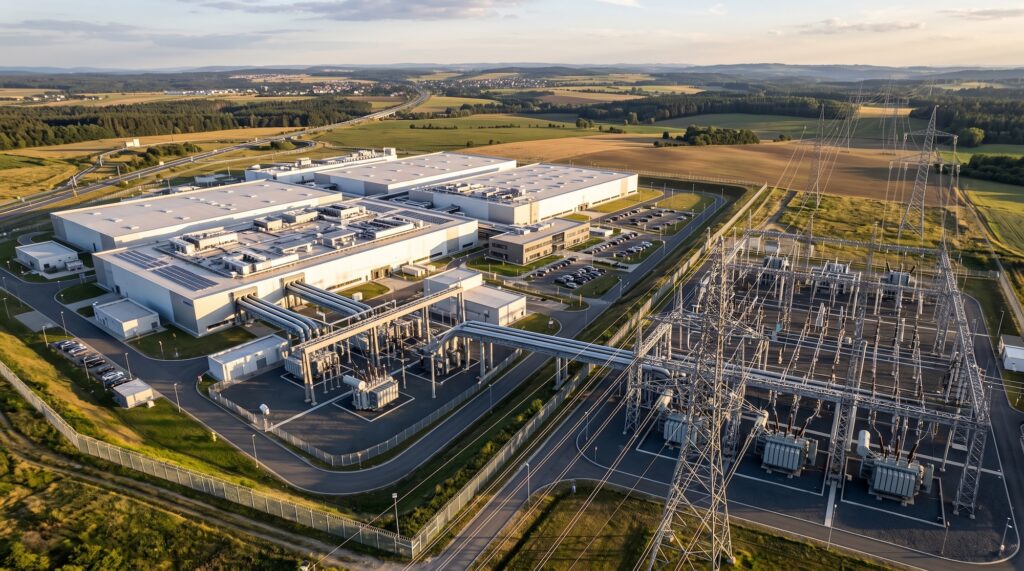
But as electricity demand grows from manufacturing, building and transportation electrification, automation, data centers, and other energy-intensive uses, power availability often determines whether a project is feasible. The issue is no longer whether electricity is available. It is whether sufficient, reliable power can be delivered in time to support both project development and operations.
Power Is Becoming a Fundamental Site-Selection Criterion
Power availability is crucial to economic development. In fact, communities without sufficient electrical capacity may be unable to compete for projects, even when their sites are otherwise attractive.
Several factors are driving growth in electricity demand. Domestic manufacturing is expanding, industrial processes are becoming more electrified, buildings are using more electricity, and transportation is shifting toward electric vehicles. At the same time, data centers and other large electricity users are adding significant new demand to the grid.
These trends mean that a site can have adequate acreage, favorable transportation access, an available workforce, and attractive incentives and still be a poor candidate if the electrical infrastructure doesn’t support the proposed use.
The issue is not simply whether a site has access to electricity, but whether sufficient power can be delivered when the project needs it. This makes “time to power” an emerging metric for evaluating project feasibility.
The issue is not simply whether a site has access to electricity, but whether sufficient power can be delivered when the project needs it
Why Time to Power Matters
There is an important distinction between power availability and the timing of power delivery. A utility ultimately may be able to provide the electricity a project needs, but if doing so requires a new substation, transmission upgrades, transformer capacity, or other infrastructure that will take several years to complete, the site may not work for a project on a much shorter development schedule.
For manufacturers and other energy-intensive users, that timing can affect the entire development process. Companies need to understand how much power is available today, how much additional capacity is required, what utility improvements will be necessary, and when those improvements can realistically be completed.
Utility lead times are becoming a development risk. As electrical infrastructure becomes more constrained, developers may face multiyear timelines for obtaining additional capacity. This can add significant uncertainty to project schedules and, in some cases, make an otherwise desirable location impractical.
Utility lead times are becoming a development risk.
As a result, power availability must be considered earlier during the site feasibility analysis. Rather than being addressed as part of later-stage due diligence, electrical capacity and utility timelines should be evaluated alongside land, transportation, labor, zoning, and other fundamental site characteristics.
Manufacturing and Industrial Development
Manufacturing provides one of the clearest examples of how rising electricity demand is changing site selection.
Modern manufacturing facilities require substantially more electricity than their predecessors as operations incorporate automation, robotics, advanced machinery, refrigeration, electric vehicle and battery production, and other electrified processes. Advanced manufacturing and reshoring are also increasing demand for industrial properties with sufficient electrical capacity.
For manufacturers evaluating multiple locations, power can therefore be a decisive factor. A preferred site may have an attractive location and strong labor and transportation characteristics but require significant utility upgrades. A less traditional location may be more competitive if it already has the electrical capacity necessary to support operations.
This is changing the sequence of the site-selection process, with power availability, utility upgrade timelines, and electricity costs considered at the beginning of the analysis rather than after a site has emerged as a leading candidate. As a result, sites that can accommodate energy-intensive operations without lengthy infrastructure improvements command a growing premium.
Warehousing, Logistics, and Electrification
Rising power demand is affecting more than traditional manufacturing.
Warehouses and distribution facilities are becoming more automated, with robotics, conveyors, automated sortation systems, and other technologies affecting electricity requirements. At the same time, the electrification of logistics fleets is creating additional demand for charging infrastructure.
These changes are reshaping what makes industrial properties attractive. Developers and users must consider not only the power needed to operate a facility today, but also the capacity required to support future charging infrastructure, battery systems, automation, and other changes in operations.
Properties with substantial electrical service have a competitive advantage over otherwise comparable facilities because they can accommodate more sophisticated or energy-intensive operations without waiting for lengthy utility upgrades. For users with time-sensitive expansion plans, that difference is significant.
Power Availability Is a Competitive Advantage
The implications extend beyond individual properties. For communities competing to attract new investment, power availability is becoming an important part of site readiness. Communities that can demonstrate available electrical capacity, reliable service, realistic utility timelines, and a path to future expansion may be better positioned to compete for energy-intensive projects.
For developers and companies, the value of a power-ready site is about more than the amount of electricity theoretically available. It is about speed and certainty. A site where the necessary power can be delivered within the project’s schedule may be more valuable than one with greater potential capacity that will not be available for several years.
For developers and companies, the value of a power-ready site is about more than the amount of electricity theoretically available. It is about speed and certainty.
Data Centers: The Most Visible Example of the Time to Power Problem
Data centers best illustrate the time-to-power issue. The rapid growth of artificial intelligence and cloud computing has made electricity availability a primary constraint on data center development in many markets. Developers are evaluating locations based on how quickly they can secure power, sometimes moving away from established data center markets toward emerging locations with greater available capacity. They are also exploring alternatives to conventional utility service, including on-site generation, battery storage, private-wire arrangements, and direct investment in power infrastructure.
For example, in Chicago, ComEd’s power-delivery timelines extend into 2032 or later. Those extended timelines are constraining near-term data center development and influencing where developers choose to build. In response, development is expanding into power-accessible submarkets and emerging markets such as Tennessee and West Texas, where available electrical capacity can support new projects more quickly.
Ultimately, the data center market demonstrates that when the time required to obtain power exceeds a project’s acceptable development timeline, power availability determines where a project is built, how it is designed, and whether it is financially feasible.
…when the time required to obtain power exceeds a project’s acceptable development timeline, power availability determines where a project is built…
What Should Be Considered During Site Selection?
As power becomes a more important site-selection criterion, companies and developers should evaluate electrical infrastructure early.
- Evaluate power early. Investigate electrical capacity and utility timelines during initial site screening. Early analysis can identify major infrastructure constraints before substantial resources are invested in a site.
- Assess timing, not just availability. A utility’s ability to eventually serve a project may not be enough. Consider when the required capacity will be available, what upgrades and interconnection requirements apply, and whether improvements can be completed within the project schedule.
- Consider existing infrastructure an asset. Existing substations, transmission and distribution capacity, and significant electrical service can give a property an advantage over comparable sites requiring major upgrades. Reliability matters too. For businesses where interruptions can cause significant production losses, evaluate grid reliability and backup-power options alongside available capacity.
- Plan for future load growth. Consider whether available infrastructure can accommodate future automation, electrification, expansion, fleet charging, and other operational changes.
Conclusion
Time to power has become a key metric in site selection as manufacturing, logistics, transportation, and other operations become more electrified and energy intensive. Location, labor, transportation, economic incentives, and real estate fundamentals remain important, but power availability is increasingly shaping which sites can realistically support new development.
The most attractive site may be the one that delivers not only the right location, but also the right amount of reliable power at the right time. For companies evaluating potential sites, that makes time to power a consideration worth addressing at the very beginning of the site-selection process, not after a site has already been selected.


Mary Ann Grena Manley
Founder and President of 15E Communications LLC, Washington, DC
Mary Ann is the Founder and President of 15E Communications LLC, a Washington, DC-based consulting firm that assists clients with communications strategy, content, business development, and public relations. Prior to founding 15E in 2020, Mary Ann managed Bloomberg Industry Group’s coverage and analysis of global environment, health, safety, and sustainability issues for more than 20 years. With experiences cutting across environmental law, policy analysis, journalism, and marketing, she most recently served as Deputy Editorial Director for Bloomberg Environment. Her areas of policy expertise include environmental compliance, environmental due diligence, risk management, brownfields redevelopment, and sustainability. Connect with Mary Ann via email, or through LinkedIn.