

ERIS Insider summarizes key news items and current trends shaping the work of environmental assessment and due diligence practitioners.
ERIS Insider Sections
In Focus
Wildfire Risk Part 2: After the Fire — Policy, Building Codes, and Redevelopment Strategies
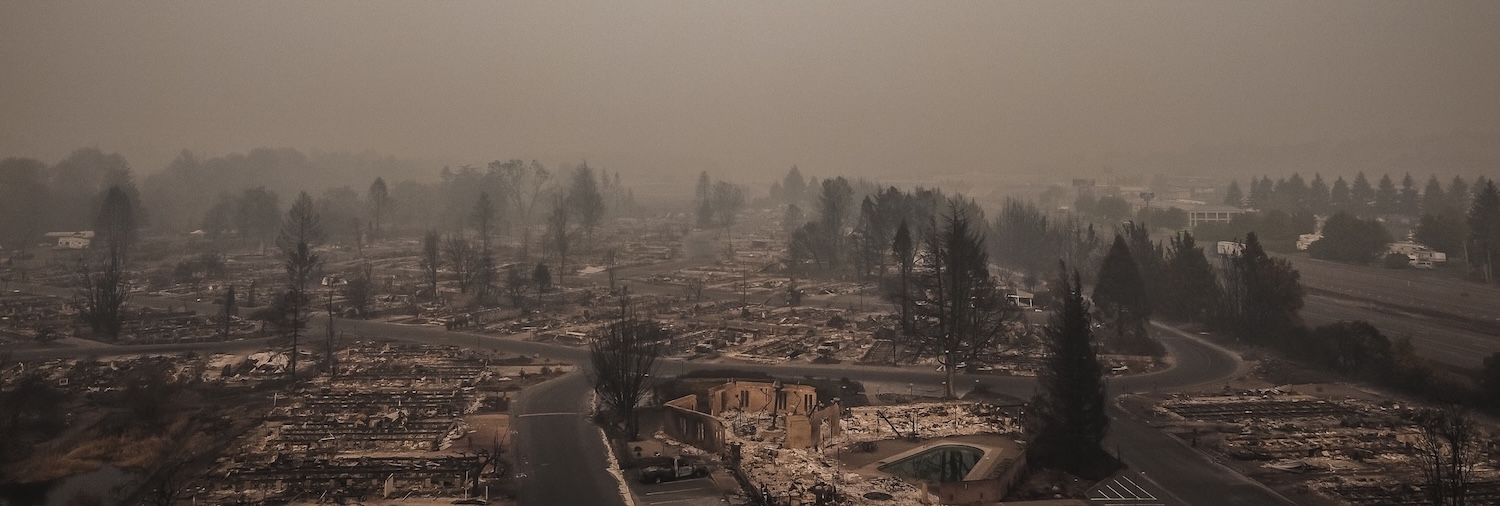
Part 1 discussed the potential liabilities associated with wildfires and the importance of incorporating those risks into due diligence practices to avoid financial exposure in acquisition and redevelopment decisions.
Identifying potential wildfire risks and liabilities is only the first step. Equally critical is understanding how policy frameworks, resilience measures, and redevelopment strategies can reduce wildfire risk and support long-term recovery after a disaster.
Wildfire-Related Policy Frameworks
Historically, federal wildfire management has focused on suppression and controlled burns. However, the devastation of urban fires, like those that wreaked havoc in Los Angeles in January 2025, has prompted some new federal wildfire prevention and response policies.
In March 2025, President Trump issued an executive order (EO 14239) directing the creation of a national resilience strategy that reallocates preparedness and resilience responsibilities from the federal government to state and local governments. Then, in June, EO 14308 consolidated wildfire management responsibilities between the Department of Agriculture and Department of the Interior into a new Wildland Fire Service. The goal is to streamline federal aid and better coordinate with local risk-mitigation efforts. However, these actions are also consistent with traditional controlled burn policies. In fact, EPA recently issued guidance promoting the use of prescribed fires as a risk mitigation tool.
Increasing Importance of Building Codes
These actions highlight the crucial role of state and local wildfire policies in wildfire mitigation. Specifically, building codes that require the use of fire-resistant building materials and establish defensible space around structures can minimize property damage, prevent fires from spreading, and help communities recover faster. These are among the most effective tools to reduce wildfire risk. But few states have incorporated wildfire resilience into their building codes.
That said, traditional building codes are increasingly incorporating green strategies, including those that address wildfire risk. Green building requirements often reference the LEED (Leadership in Energy & Environmental Design) rating system, the most widely used green building certification in the world. LEED is a holistic framework that addresses water and energy use, waste management, materials selection, and other environmental issues.
LEED v5 focuses on proactive planning and resilient design to guard against climate hazards such as wildfires. All LEED projects must now complete a climate-resilience assessment to evaluate wildfire risk and other hazards to inform the design process and integrate resilient design measures.
California, Colorado, Nevada, Pennsylvania, Oregon, and Utah have adopted wildfire-related building codes that all require the use of fire-resistant construction materials in high-risk areas. And all these state codes align with or reference LEED, except Pennsylvania, which relies on the International Energy Conservation Code, or IECC.
Summary of State Wildfire-Related Building Policies:
- California requires new and existing structures in wildland-urban interface (WUI) areas to use ignition-resistant materials, including fire-rated roofing, fire-resistant siding like stucco or fiber cement, and ember-resistant vents. However, the California Board of Forestry and Fire Protection has missed two deadlines to approve regulations implementing ember-resistant zones in wildfire-vulnerable communities. Those regulations remain in limbo, with the board set to resume work on them in March 2026.
- Colorado requires construction in WUI areas to use materials like Class A roofing, ember-resistant vents, and tempered glass windows to resist wildfire and wind-blown embers.
- Nevada’s requirements include the use of ignition-resistant construction materials in high-risk areas and buffer zones between structures and undeveloped wildland.
- Pennsylvania’s wildfire building codes mandate specific construction methods and materials for buildings in WUI areas, which include requirements for access roads, water supply, and ignition-resistant materials for exterior walls and roofs.
- Oregon requires property owners in high-risk areas to harden their buildings against wildfire risk and implement defensible space.
- Utah requires new construction in WUI areas to use ignition-resistant materials, such as Class A roofs and noncombustible exterior walls, and has specific requirements for building components such as windows, eaves, and decks.
In addition to LEED, the IECC and the International Wildland-Urban Interface Code (IWUIC) can inform best building code and green construction practices. The IECC is a model building code that sets minimum energy efficiency standards for new residential and commercial construction in the U.S., covering insulation, windows, HVAC, lighting, and other issues. The IWUIC is a model code designed specifically for wildfire risk in WUI areas where development meets wildland vegetation.
Real Estate Developers & Consultants Fill the Gap
In states without wildfire prevention requirements, real estate developers have stepped into the regulatory gap, actively working to minimize fire risk. They recognize that hazardous air quality and electricity outages caused by wildfires lead to business interruptions and increased costs for air filtration and other technologies. Wildfire damage also leads to higher insurance premiums and depressed real estate values.
Developers and their consultants increasingly rely on structured, property-level resilience assessments. ASTM’s Standard Guide for Property Resilience Assessment (E3429-24) provides a framework for evaluating wildfire exposure across site conditions and structures and for informing redevelopment and resilience investments where wildfire requirements are limited or inconsistent.
In practice, developers are protecting residential and commercial buildings through structure hardening, strategic density in lower-risk areas, and evacuation route planning. Many developers actively participate in wildfire resilience programs and educate tenants about fire-safe landscaping. Consultants can help by providing developers with crucial historical and current property data to identify potential wildfire risks and environmental liabilities.
Strategic Planning for Redevelopment
Following a major wildfire event, redevelopment planning shifts from site-level risk mitigation to coordinated recovery and rebuilding at the community scale. Strategic planning for redevelopment is essential to ensure that rebuilt structures are safer and more resilient. Investing in wildfire-resistant buildings and other resilience policies not only protects communities but can also save billions of dollars in future losses.
For example, following the 2017 Tubbs Fire that destroyed 5,300 homes, Sonoma County created an Office of Recovery & Resiliency to coordinate rebuilding and recovery efforts. The goal was to make the county more resilient to future wildfire disasters. To that end, county leaders invested in infrastructure improvements, vegetation management, a new alert system, and other related projects.
The 2018 Camp Fire in Paradise, California, was one of the deadliest wildfires in U.S. history, destroying more than 18,000 structures. In the aftermath, the town focused heavily on rebuilding with fire-resilient infrastructure. One of their solutions was investing in noncombustible buildings, called the Q cabin, constructed out of steel.
Other strategic redevelopment solutions include:
- standardizing debris removal protocols so that property owners can return to their buildings sooner,
- fast-tracking permitting and inspections to expedite rebuilding,
- addressing labor and supply chain issues that affect construction timelines,
- stabilizing the property insurance market to ensure continued coverage (in California, specifically, for the examples above), and
- offering mortgage forbearance to help fire victims return to their communities.
Additional best practices include prioritizing community engagement and incorporating wildfire-resilient vegetation and land-use management practices.
Cleanup is also an important part of the redevelopment process. Keep in mind that wildfire cleanup isn’t just about removing burnt structures and vegetation. Many buildings contain or store hazardous materials and chemicals (such as asbestos, lead, pesticides, propane, and gasoline) that may be released in the wake of a wildfire. These materials must be cleaned up in accordance with local, state, and federal laws. Revisit Part 1 of this series for more information on cleanup standards and protocols.
Conclusion
Wildfire risk can no longer be addressed solely through emergency response or post-disaster recovery. Instead, it is increasingly shaped through building codes, redevelopment decisions, and coordinated resilience efforts that influence how communities rebuild after a fire. As these risks continue to grow, aligning policy frameworks and resilient construction practices will be critical to rebuilding safer communities and reducing future losses.
CRE Market Update
The Latest Market Updates in the U.S. Commercial Real Estate Industry (Q3 2025)
Another Quarter of Improved Investment Activity
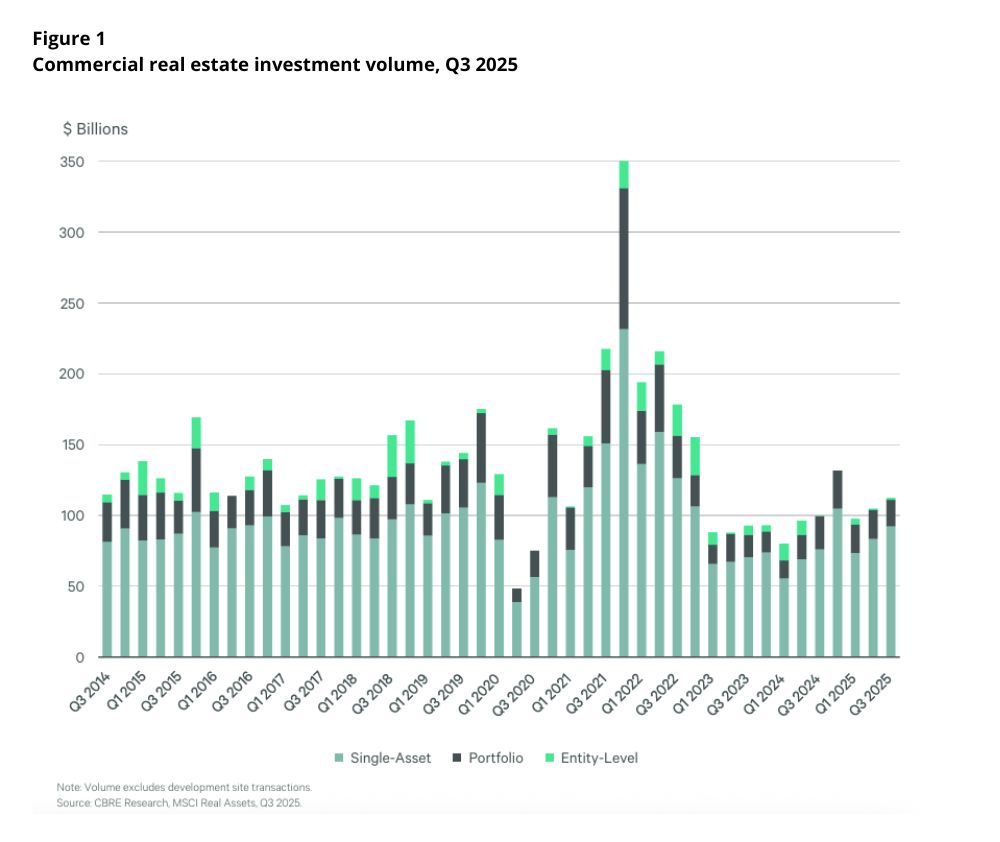
According to CBRE Research, in Q3, commercial real estate investment volume increased by 13% year-over-year to $112 billion. Single-asset sales grew by 21% year-over-year, reaching $92 billion, while portfolio sales fell by 21% to $19 billion (Fig. 1). Entry-level investment volume jumped by 46% year-over-year due to a single $12 billion data center transaction.
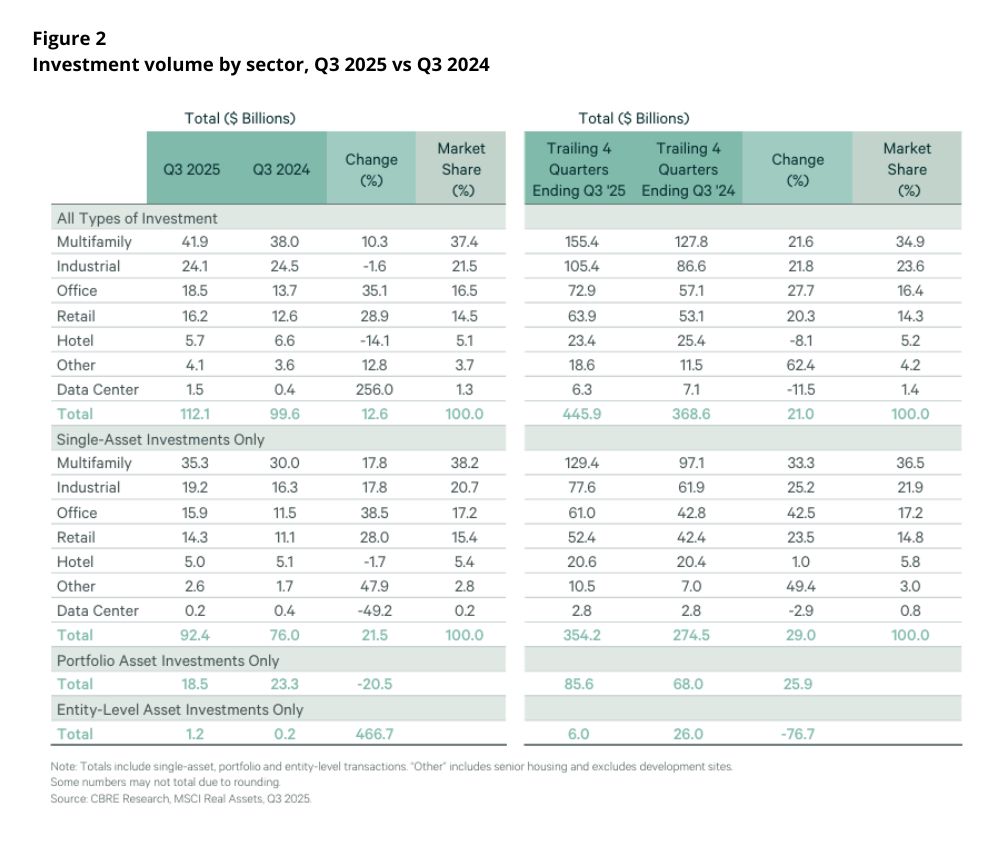
Once again, multifamily properties led all property types for investment volume, increasing by 10% year-over-year to $42 billion (Fig. 2). The industrial and logistics sector ranked second again, recording $24 billion in investment volume, down by 2% year-over-year. The retail and office sectors had the strongest growth in investment volumes. Office investment rose 35% year-over-year to $19 billion in Q3, while retail investment increased by 29% to $16 billion. Data center investment increased 256% year-over-year to $1.5 billion, due to that single $12 billion transaction mentioned above.
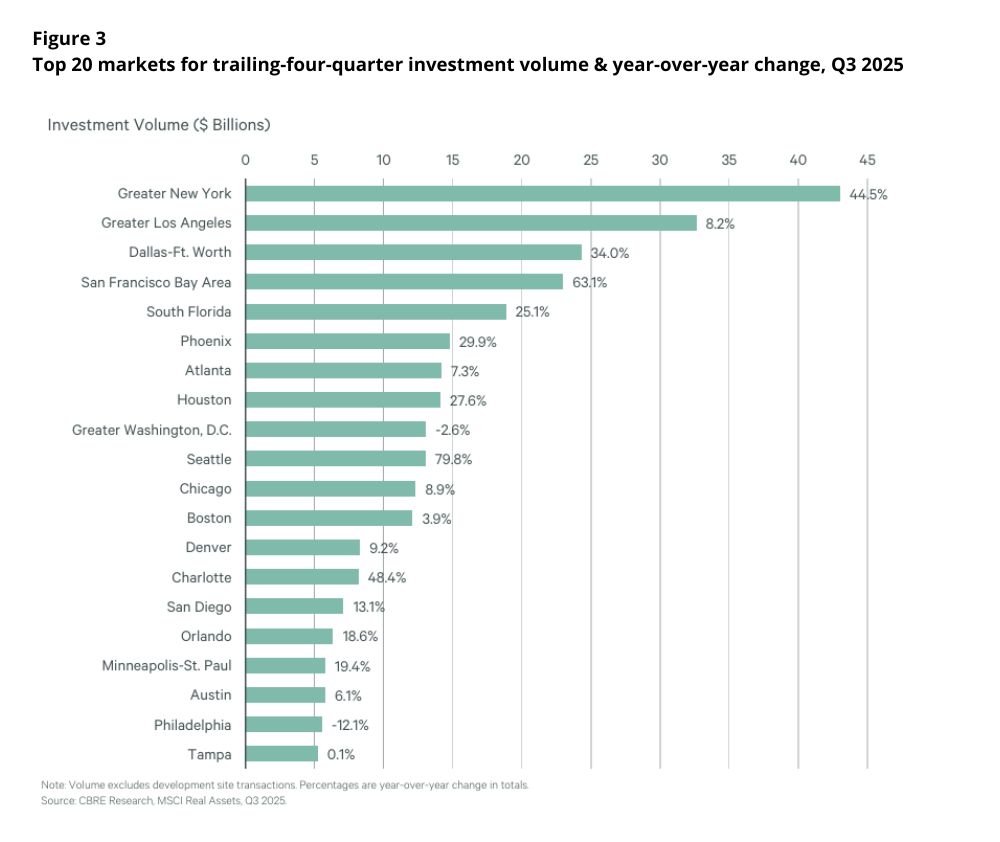
For the prior four quarters ending in Q3 2025, New York continued to lead the market with $43 billion, followed by Los Angeles at $33 billion, and Dallas-Ft. Worth at $24 billion (Fig. 3). Among the top 20 markets, Seattle had the largest year-over-year increase of 80%, followed by the San Francisco Bay Area (63%) and Charlotte (48%).
Private investors had the largest share of investment volume for the fifth consecutive quarter, accounting for $68 billion – 61% of Q3 volume, representing a 14% increase from a year ago (Fig. 4). Institutional investment volume rose by 17% year-over-year to $23 billion, accounting for 21% of total volume. Inbound cross-border investment volume fell by 35% year-over-year to $47 billion; but excluding two large portfolio transactions last year, cross-border volume rose by 5%. Institutional investors and REITs/public companies were net buyers in Q3, while private and cross-border investors were net sellers.
Source: CBRE Research, Q3 2025

To view larger images and dive deeper into the data, click on the images above.
Latest Developments
The WOTUS Pendulum Swings Again: EPA Proposes New Definition that Narrows Jurisdiction
In November 2025, EPA and the Department of the Army proposed a rule to revise the definition of “waters of the United States” (WOTUS). The new definition is an attempt to implement the Supreme Court’s 2023 decision in Sackett v. EPA and erase lingering uncertainty about how to interpret WOTUS.
The proposed rule narrows the scope of waters regulated under the Clean Water Act (CWA) by tightening core jurisdictional definitions and expanding exclusions. Intrastate lakes and ponds that are isolated and not traditionally navigable would no longer automatically qualify as WOTUS. For waters to be jurisdictional, they must now be “relatively permanent,” defined as standing or continuously flowing surface waters that persist year-round or at least during predictable wet seasons.
Wetlands must also have a clearly defined “continuous surface connection” to a jurisdictional water, meaning they must physically abut such waters with surface water present at least during the wet season. The rule also newly defines “tributary” as a relatively permanent water with a bed and banks that connects to navigable waters through other relatively permanent features.
Several exclusions are clarified or expanded. Waste treatment systems, including lagoons and treatment ponds, remain excluded but are more clearly defined. Prior converted cropland loses its exclusion if abandoned for five years and reverts to wetlands. Ditches are redefined broadly as constructed channels and no longer become WOTUS due to permanent flow. Groundwater is expressly excluded for the first time.
Overall, the rule would substantially reduce federal CWA jurisdiction, resulting in fewer regulated waters, permits, and compliance obligations.
Public comments were due by January 5, 2026.
Regulatory Uncertainty, Real Deadlines: Where California’s Climate Disclosure Laws Stand

California’s ambitious climate disclosure agenda has become another flashpoint in the regulatory tug-of-war over mandatory reporting obligations. In November, the U.S. Court of Appeals for the Ninth Circuit issued a preliminary injunction barring enforcement of Senate Bill 261 (SB 261). The injunction follows a challenge filed by the U.S. Chamber of Commerce and other trade groups, who argued that the law likely violates the First Amendment by compelling companies to publicly disclose climate-related financial risks.
The lawsuit also challenges Senate Bill 253 (SB 253), which requires large public and private companies that do business in California to disclose their greenhouse gas emissions publicly, but that law was not enjoined. While SB 261’s initial disclosure deadline, January 1, 2026, was imminent, SB 253’s first reporting is not due until mid-2026.
Because of this ruling, the California Air Resources Board (CARB) issued an Enforcement Advisory formally acknowledging the stay and confirming that it will not penalize entities that fail to file SB 261 reports by the January 1 statutory deadline. However, CARB also opened a public voluntary docket for companies that wish to file SB 261 reports despite the injunction.
In its advisory, CARB asked voluntary filers to submit a company statement on official letterhead along with a link to the company’s publicly posted climate-risk report. The agency also said it will provide an alternative date for mandatory reporting, if necessary, once the Ninth Circuit resolves the appeal, with oral arguments taking place January 9, 2026.
Rulemaking Process Still Underway
Despite the ongoing legal proceedings, CARB has proposed implementing regulations for both SB 261 and SB 253 that address applicability criteria and exemptions, definitions, fee calculations, and enforcement, and set an August 10, 2026, reporting deadline for SB 253. Public comments on the draft regulations are due by February 9, 2026. CARB will then hold a public hearing on February 26.
ERIS previously examined SB 261’s scope, reporting obligations, and early compliance considerations in a blog post published at the time of enactment, providing background that remains relevant as litigation and rulemaking continue.
Manufacturing Demand Spurs Momentum for Brownfields Redevelopment

Increased demand for U.S. manufacturing presents a massive opportunity for brownfields redevelopment, said Michael Taylor, founder and president of Vita Nuova and chair of the Redevelopment Institute, during a recent webinar exploring why this redevelopment is critical to local economic strategy.
While demand for industrial development sites has never been higher, site availability has reached critically low levels, Taylor explained in the Redevelopment Institute webinar, “Carpe Diem: Why Redevelop Brownfields Now?” But this also presents a unique opportunity for rural communities once bolstered by local manufacturing. With the right support, these small towns can revitalize abandoned manufacturing sites, attract new jobs, and rebuild their communities.
Major tech, pharmaceutical, and other companies have already pledged more than $10 trillion in investment in American manufacturing, but that will occur over time, Taylor said. That’s where government support comes in.
Federal Funding
Brownfields redevelopers can still access historically high levels of Bipartisan Infrastructure Law (BIL) funding. EPA is currently accepting applications for $255 million in brownfields funding, with applications due January 28, said Sarah Sieloff, an urban planner at Haley & Aldrich. However, the historic levels of BIL funding will then expire. In its advocacy for reauthorization of the federal brownfields program, the National Brownfields Coalition, which is co-managed by Smart Growth America and the Center for Creative Land Recycling, is advocating for program stability, bipartisan continuity, and sustained investment.
Legislative Developments
Restoration of the federal brownfields cleanup tax deduction is another policy priority, said Kennedy O’Dell, director of Advocacy at Smart Growth America. The Brownfields Redevelopment Tax Incentive Reauthorization Act (H.R. 815) would allow businesses to immediately deduct environmental cleanup costs for contaminated properties in the year incurred, making redevelopment more financially feasible. The Brownfield Revitalization and Remediation Act (H.R. 5472) expands the scope of eligible expenses but may pose implementation challenges.
You can watch the full webinar recording here.
State Developments
New Jersey Dials Back Reporting Obligations Under Reproposed AAI Rule

In October 2024, the New Jersey Department of Environmental Protection (NJDEP) proposed a rule that would have required anyone conducting due diligence at real properties to report any discovered discharges of contamination to both NJDEP and the record owner of the property. But following pushback from the regulated community citing concerns about the impact of proposed changes on property transactions and site remediation efforts, in November 2025, NJDEP withdrew its original proposal and offered a different approach.
Under the reproposed rule, only the record property owner must be notified if a discharge is discovered during the due diligence process. This reporting obligation applies to anyone conducting due diligence, including environmental consultants and licensed site remediation professionals. Then, the property owner would be legally required to report the contamination to NJDEP under the New Jersey Spill Act and to begin remediation.
Public comments on the new proposal were accepted through January 16.
Thank you to STP ComplianceEHS for contributing the articles under State Developments in this edition.

Lenders Corner
CRE in 2026: Stability Returns

Dave Colonna, Director, Lender Solutions, ERIS
As we look ahead to what 2026 may bring for commercial real estate markets, one theme stands out: cautious optimism. After years of volatility, we’re entering 2026 with greater clarity. Market conditions are improving as prices begin to stabilize and investors return to the market with renewed confidence. Colliers expects transaction volume to grow 15-20% in the coming year as capital markets regain momentum.
As always, interest rates will play a critical role in shaping the CRE landscape. Most forecasts suggest rates will decline modestly, potentially reaching a 3% federal funds rate by year-end. Even with lower borrowing costs, owners of older office buildings may still face refinancing at higher rates than their existing debt, increasing the likelihood of forced sales and a rise in distressed assets.
The AI boom has contributed meaningfully to overall economic conditions and to CRE in particular. Cushman & Wakefield estimates that more than half of GDP growth in 2025 can be attributed to AI-driven investment. Data centers have shifted from a niche industrial asset to a mainstream, high-demand CRE investment, viewed by investors as reliable long-term income generators – something few other property types have offered in recent years.
Overall, 2026 appears to be less about a broad-based boom and more a return to stability, characterized by disciplined development, selective opportunity, and a more resilient foundation for long-term growth.
Practice Tip
Vapor Intrusion: The Due Diligence Risk You Can’t Afford to Miss

This edition’s Practice Tip Presented by:

Contributing Authors: Mark Johnson, Senior Principal and Rafat Abbasi, PE, Senior Consultant, Geosyntec Consultants.
Effective environmental due diligence is critical during property transactions, especially at sites with potential contamination that could lead to concerns with the migration of volatile chemicals from soil or groundwater into occupied buildings, also known as vapor intrusion (VI). While ASTM E1527-21 requires consideration of vapor migration, Phase I ESAs alone often cannot fully capture the complexity of VI pathways. For example, a prior release from over 20 years ago was evaluated during diligence at the time and determined to not pose a risk. However, in today’s regulatory environment, where many states now have robust vapor intrusion frameworks, this historical release may present a newly recognized risk.
Beyond the Phase I
Because vapor intrusion can stem from historic activities, nearby contaminated properties, or hidden subsurface impacts, many sites require additional investigation beyond Phase I. Phase II soil gas or indoor air sampling, and evaluation of on-site and off-site contamination sources, often are necessary to accurately assess risk. Each of these actions can be initiated at the Phase I level – saving critical time in planning during the limited diligence period. For example, environmental auditors completing Phase I ESAs should be well versed in Phase II sampling programs to be able to “scope” anticipated VI sampling approaches at the time of Phase I site reconnaissance. Failure to anticipate these steps can lead to unexpected investigation costs, regulatory delays, and cleanup obligations.
Site-Specific Evaluation is Critical
Regulatory hurdles vary across jurisdictions, making early, site-specific evaluation essential. Local specialists should be engaged when designing VI studies to help avoid costly “re-do” work down the road. For example, some states will require that indoor air samples be collected concurrently with sub-slab samples; missing the indoor air data could render the sub-slab data rejected with regulatory submittals.
Comprehensive due diligence, which includes evaluation for potential VI issues early in the process, helps uncover hidden costs, supports fair property negotiations, enables access to brownfield programs, and reduces long-term liability. Experienced environmental professionals provide crucial guidance by navigating local regulations, interpreting complex data, and identifying risks early to support safe and successful redevelopment.
ASTM Developments

Mark Your Calendars for Committee Week in Dallas
We’re looking forward to connecting with clients and industry peers at this spring’s ASTM Committee E50 Week, taking place March 23–25 at the Hyatt Regency Dallas. This biannual event brings together professionals from across environmental assessment and risk management to collaborate, share insights, and discuss emerging challenges and innovations shaping the industry.
Representatives* from ERIS will be on site throughout the week, participating in meetings and discussions that help inform best practices and standards in environmental due diligence. Committee Week is always a valuable opportunity to exchange perspectives, stay aligned with evolving standards, and engage in thoughtful dialogue with industry leaders from across the country. The meetings are open to all those involved in environmental assessment and risk management.
ERIS is also pleased to sponsor the evening social on March 25. These informal gatherings offer a great chance to reconnect with colleagues, meet new contacts, and continue conversations from the day in a relaxed setting.
If you’ll be in Dallas, we hope you’ll join us during the meetings and at the evening social. We look forward to connecting and continuing conversations that help move our industry forward.
*Amanda Sugg, Regional Account Manager – Texas; Nick Freeman, Director, Sales; Tom Hamill, Director, National Accounts
Featured ERIS Product
Data You Can Trust: How ERIS Ensures Accuracy at Every Step

At ERIS, data isn’t just part of what we do; it is our business. As a leading provider of environmental and property due diligence data, historical information, and software solutions across the U.S., Canada, and Mexico, our focus is on delivering accurate, up-to-date insights through tools that integrate seamlessly into your workflow.
Our data provides the first line of investigation into property attributes that determine environmental risk. Drawing from thousands of federal, state, county, municipal, and tribal data sources, we compile a comprehensive survey of records that are carefully geocoded to specific property locations and surrounding areas. Whether you’re evaluating a single site or a large corridor or parcel, our data helps identify potential environmental concerns early and reliably.
Precision is ensured through a rigorous, multilayered quality assurance process – from initial data collection and analysis through loading, staging, cleansing, and geocoding, every step is governed by strict validation rules designed to improve accuracy and detect data loss from the source. Automated scripts and controls improve consistency and efficiency, while final manual reviews ensure nothing is missed. In fact, ERIS is the only company in the industry to conduct a five-step, human-led QA/QC review of reports before delivery.
Our data is continuously updated monthly, quarterly, biannually, or annually, depending on source availability, so you are always working with the most current information. And while we invest heavily in automation to improve speed and efficiency, we never compromise on manual inspection. Our experienced team of report analysts carefully reviews each order, because we know the accuracy of your findings is critical to you and your clients for risk avoidance.
Spotlight On
Special Profile: Vanitha Vadivelu, Vice President, Product & Technology

Vanitha Vadivelu
Vice President, Product & Technology
Since joining ERIS in 2014, Vanitha has played a pivotal role in shaping the technology and products that support our clients every day. She was an integral part of the Technology team during ERIS’ U.S. expansion, contributing to the successful launch of several cornerstone solutions, including the ERIS Order Portal, Xplorer, Figure Creator, Mobile Application, ERIS Direct, and Scriva.
Today, as Vice President, Product & Technology, Vanitha leads system, application, and product development across our core platforms and emerging initiatives. Currently, an important focus for Vanitha is understanding how AI can strengthen ERIS’ applications and enable clients to do more, without sacrificing the expertise and judgment that underpin their work.
She oversees cross-functional teams spanning development, quality assurance, technical support, and project management, ensuring the delivery of secure, scalable, and client-focused solutions. Her work is deeply collaborative, involving close partnership with internal teams, clients, and external partners to ensure technology investments align with business goals and evolving client needs.
Vanitha’s standout strength is her ability to direct multiple priorities simultaneously while remaining consistently accessible to her teams and cross-functional partners in marketing, sales, and client services. It’s a balance of strategic focus and day-to-day engagement that brings real value to her role.
A true embodiment of the ERIS brand, Vanitha is known for being responsive, approachable, and deeply committed to achieving company objectives and fulfilling client expectations. Outside of work, she recharges through meditation and enjoys spending time with family, reading, and cooking – practices that help her maintain focus, creativity, and balance in a fast-moving technology landscape.
Upcoming Events

Feb 2-6, Anchorage, AK: Meet Maggie Losoya at the Alaska Forum 2026.
Feb 9-12, San Diego, CA: Join Team ERIS at the EBA 2026 Conference.
Feb 26, Denver, CO: Meet Melissa Nelson at EPIC RemFest.
Feb 26, Pelham, AL: Jeanie Bunt will attend the Annual Environmental Professionals’ Conference.
Mar 4-5, Phoenix, AZ: Meet Melissa Nelson and Frank Dickerson at the EPAZ Annual Conference.
Mar 23-25, Dallas, TX: Join Team ERIS at the ASTM E50 Committee Week.
Mar 25-26, New Brunswick, NJ: Meet Ashley Miller at LSRPA’s New Jersey Site Remediation Conference.
Mar 26, Dallas, TX: Meet Amanda Sugg at EPIC RemFest.
Apr 2, Clemson, SC: Join Team ERIS at Clemson University’s Hydrogeology Symposium.
Apr 16, Atlanta, GA: Meet Jeanie Bunt at the Georgia Brownfield Seminar.
Apr 29 – May 1, Stuart, FL: Meet Jeanie Bunt at the FAEP Conference 2026 hosted by the Treasure Coast Chapter (TCC).
Thank you for reading this issue of ERIS Insider quarterly newsletter.
Our next issue will drop in April.